








When Water Becomes Weight
The fundamental trigger for most monsoon landslides is simple: water saturation. A hillside that appears solid is often a mix of soil, fractured rock, and debris. During prolonged or intense rainfall, this material acts like a sponge, soaking up water.
As the ground becomes saturated, two things happen. First, the water adds immense weight to the slope. Second, it increases what is known as pore water pressure — the water pushes soil and rock particles apart, drastically reducing the friction and strength that holds the mass together. A slope that was stable when dry can suddenly lose its grip and fail, moving downhill under the force of gravity. This can happen with startling speed, often after hours of rain when the ground reaches a critical tipping point.
Mumbai's Unstable Slopes
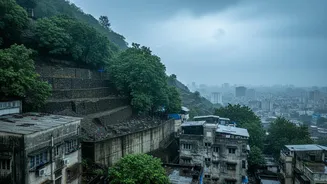
Mumbai’s unique geography creates a perfect storm for landslides. The city is not just flat; it features several hillocks and ridges, particularly in suburbs like Ghatkopar, Chembur, Kurla, and Vikhroli. These areas are composed of jointed rock formations and loose soil, which are naturally vulnerable to failure during heavy rain. The Mumbai Climate Action Plan (MCAP) has identified 249 landslide-prone locations, highlighting that the combination of steep terrain and increasing extreme rainfall events heightens the risk. Many of these areas are former quarry sites where excavation has already altered and weakened the natural stability of the terrain, leaving behind unnaturally steep slopes.
The Human Factor: A Risk We Build
While rain and geology set the stage, human activity is a powerful and often decisive amplifier of landslide risk. Experts consistently point to unchecked construction, deforestation, and illegal encroachments as primary drivers of slope instability. Cutting into the base of a hill to make space for housing removes the slope's natural support. At the same time, clearing vegetation and trees from hillsides eliminates the root systems that help bind the soil together. In many of Mumbai's most vulnerable areas, informal settlements have expanded up the slopes, with structures built on fragile land without proper engineering or foundations. This not only puts the residents of these homes in direct danger but also destabilises the entire hillside, increasing the risk for those living below. The weight of these structures and changes to natural drainage patterns further aggravate the situation.
When Warnings Are Ignored
The threat is not unknown. For years, government bodies like the Geological Survey of India (GSI) have mapped Mumbai's vulnerable zones and provided specific recommendations to the Brihanmumbai Municipal Corporation (BMC). Reports have warned about specific hillsides being at high risk, recommending measures like building retaining walls, ensuring proper drainage, and halting further construction. However, these warnings have not always been heeded, and mitigation projects often remain incomplete. In some cases, residents have reportedly blocked weep holes in retaining walls — designed to let water escape and relieve pressure — which weakens the structures and can lead to their collapse. Recent tragic landslides have renewed calls for a comprehensive safety audit of all at-risk areas and the relocation of families living in the most dangerous locations.
Warning Signs You Can See and Hear
For residents living on or near slopes, recognising the early warning signs of an impending landslide can be life-saving. These are not always dramatic; often, they are subtle changes in the environment. Be alert for new cracks appearing in walls, floors, or foundations, or doors and windows that suddenly begin to stick or jam for the first time. Outside, look for changes in the landscape: new bulges or depressions in the ground, tilting trees, fences, or utility poles, and soil pulling away from foundations. The appearance of new springs or seepages of water on a slope that is normally dry is a critical warning sign. Unusual sounds, like trees cracking, boulders knocking together, or a faint rumbling that grows louder, can indicate that debris is already moving and immediate evacuation is necessary.