


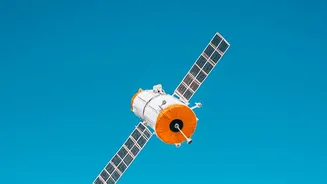
The Inescapable Problem of Drag
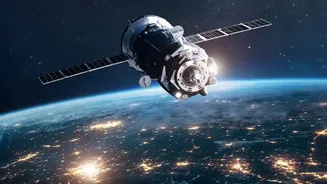
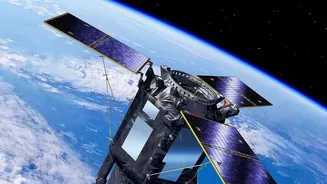
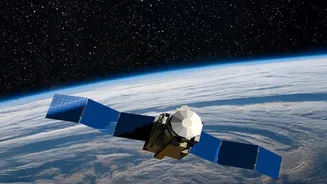
Low-Earth Orbit (LEO) and Very Low-Earth Orbit (VLEO) are the place to be for modern satellites. Ranging from roughly 160 to 2,000 kilometers up, these orbits are ideal for Earth observation, telecommunications, and scientific research. Proximity to Earth means
higher-resolution images and lower communication latency. But there’s a catch. Even at these altitudes, the atmosphere isn't a true vacuum. It’s incredibly thin, but it's still there. As a satellite whips through this sparse environment at over 7 kilometers per second, it collides with countless air molecules. This creates a persistent frictional force known as atmospheric drag, which acts like a constant brake on the spacecraft. This drag saps the satellite's orbital energy, causing its altitude to gradually decrease in a process called orbital decay. Left unchecked, drag will inevitably pull a satellite back into the thicker parts of the atmosphere, where it will burn up.
The Old Solution: Heavy Fuel Tanks
For decades, the only way to combat orbital decay was for a satellite to periodically fire its own onboard thrusters, giving it a re-boost to maintain its altitude. Space stations and major observatories like the Hubble Space Telescope have been doing this for years. This method, however, has a fundamental limitation: fuel. Most satellites carry a finite amount of propellant, such as xenon gas. Once that fuel runs out, the mission is effectively over, regardless of whether the satellite's scientific instruments are still working perfectly. This is especially problematic in VLEO (altitudes below 400km), where the denser residual atmosphere creates much stronger drag, potentially draining a satellite's fuel in a very short time. The weight of the propellant also adds to launch costs, making missions more expensive.
A New Way to Breathe: Air-Breathing Propulsion
What if, instead of fighting the atmosphere, a satellite could use it to its advantage? That is the revolutionary concept behind Air-Breathing Electric Propulsion (ABEP), also known as RAM-EP. This technology flips the script on atmospheric drag. Instead of carrying its own propellant, an ABEP system uses a specially designed intake to scoop up the sparse atmospheric molecules it encounters along its orbital path. These captured particles—mostly nitrogen and highly reactive atomic oxygen—become the propellant. The system then uses electricity, typically generated by solar panels, to ionize (electrically charge) these particles and accelerate them out of a thruster at high velocity. This expulsion generates a small but constant thrust that precisely counteracts the force of drag, allowing the satellite to maintain its orbit indefinitely without ever running out of fuel.
The Game-Changing Benefits
The implications of this technology are enormous. By effectively creating satellites with unlimited propellant, ABEP enables a new class of long-duration missions in VLEO. Satellites can orbit for years at lower altitudes, providing higher-quality Earth imagery, faster internet communications, and more detailed atmospheric science. This also promotes space sustainability. Since these satellites operate in an orbit where drag is significant, they will naturally de-orbit and burn up at the end of their operational life when the propulsion system is turned off. This prevents the accumulation of dangerous space debris that plagues higher orbits. Furthermore, eliminating heavy fuel tanks could lead to lighter satellites and reduced launch costs, making space more accessible.
The Road to an Orbital Future
Air-breathing electric propulsion is no longer just a theory. The European Space Agency (ESA) successfully tested a ground-based prototype, proving the concept is viable. Since then, a number of government agencies and private companies have been racing to develop the technology. In the US, DARPA has awarded contracts to companies like Phase Fourth and CU Aerospace to develop air-breathing systems for military and commercial use. In India, the startup Orbitt Space is developing its own ABEP technology, while European firms like TransMIT GmbH continue to refine the core components under ESA contracts. While technical challenges remain, such as optimizing the intake design and ensuring materials can withstand the corrosive effects of atomic oxygen, the path is clear. The technology is rapidly maturing from research and development into the demonstration phase.