



The Planet in the Spotlight
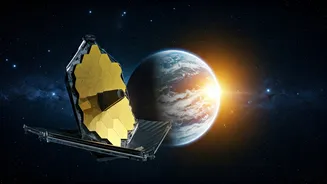
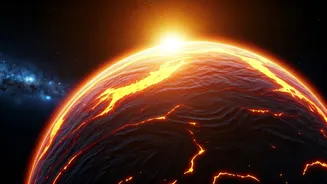
The subject of this intense new study is an exoplanet named K2-18b, located about 120 light-years from Earth in the constellation Leo. It’s a fascinating world, classified as a 'sub-Neptune'. At 8.6 times the mass of Earth, it’s much larger than our own
rocky planet but potentially smaller than the ice giants in our solar system. What makes K2-18b particularly special is its location within its star's habitable zone—the orbital distance where conditions could allow for liquid water to exist on a planet's surface. Scientists have theorized it might be a 'Hycean' world: a hot planet covered by a vast ocean, with a hydrogen-rich atmosphere. It’s precisely these kinds of worlds that astronomers are eager to study for signs of life.
A Tantalising Chemical Signal
The big news from the latest Webb observations is the strengthened evidence for a molecule called dimethyl sulfide (DMS) in K2-18b's atmosphere. This is significant because, on Earth, DMS is overwhelmingly produced by life, particularly by microscopic marine organisms like phytoplankton. Its presence is part of what gives the sea its distinctive smell. While previous observations in 2023 hinted at DMS, the signal was weak. New data, using different instruments on Webb, have provided a much stronger—though not yet definitive—detection. Researchers are cautious, emphasizing this is not a confirmation of alien life. However, finding a potential biosignature in such abundance is a landmark moment.
How Webb 'Sees' an Alien Atmosphere
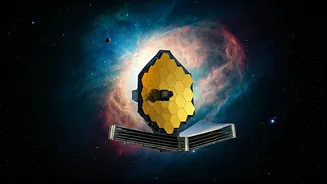
So, how does a telescope 120 light-years away analyze the air of another world? Webb uses a technique called transmission spectroscopy. As K2-18b passes in front of its host star from our perspective, a tiny fraction of the starlight filters through the planet's atmosphere. Different gases in that atmosphere absorb specific colours, or wavelengths, of light. Webb's advanced spectrographs act like a prism, spreading the starlight into a rainbow and allowing scientists to see which 'colours' are missing. These missing pieces, called absorption lines, act as chemical fingerprints, revealing the molecules present—like methane, carbon dioxide, and now, potentially, DMS.
The Scientific Debate
The findings have ignited a healthy and vigorous debate among scientists. While the detection of DMS is tantalising, many experts urge caution. Some studies suggest that abiotic, or non-biological, processes could potentially produce DMS under the unique chemical and physical conditions of a Hycean planet's atmosphere, even without life. Other analyses of the data have proposed that different molecules could account for the signal Webb detected. The scientific process is working as it should: an extraordinary claim requires extraordinary evidence. The original team stands by its analysis, noting that the observed abundance of DMS aligns with predictions for a living ocean world, but agrees that more data is needed to reach a conclusive answer.
What Comes Next in the 'Feed'?
This study is just one part of the continuous 'feed' of information from the James Webb Space Telescope. The team behind the K2-18b discovery has requested more observation time to hopefully confirm the DMS signal with higher statistical confidence. To move from a tantalising hint to a confirmed discovery, scientists need to reach a 'five-sigma' level of certainty, meaning there's less than a one-in-a-million chance the signal is a random fluke. The current evidence is around 'three-sigma'. Beyond K2-18b, Webb is studying the atmospheres of dozens of other exoplanets, from rocky worlds in the TRAPPIST-1 system to bizarre gas giants, building a library of alien skies that will help us understand our place in the cosmos.