






A Crisis of Timing
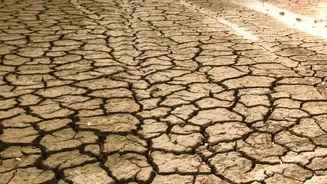
Ladakh, a cold desert in the Himalayas, receives very little rainfall and has long depended on a precise natural clock. Its agricultural communities, which primarily grow crops like barley and apples, need water in the crucial spring planting months of
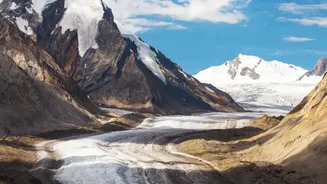
April and May. Traditionally, this water came from the slow melting of glaciers. However, due to climate change, winters now have less snowfall, and the glaciers are receding. What snow does fall often melts too early, in February or March, long before the sowing season begins. The larger, deeper glaciers, meanwhile, don't release their meltwater until late summer, leaving farmers with a critical water gap in spring. This scheduling disaster threatens the very survival of farming in the region.
An Idea Inspired by Simple Physics
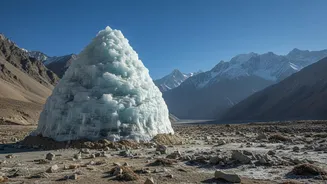
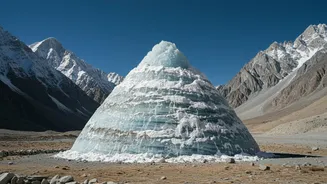
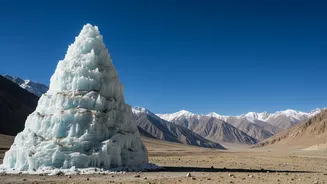
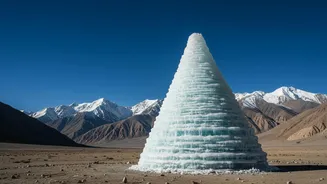
The solution came from engineer and innovator Sonam Wangchuk. He noticed a patch of ice that had survived the summer heat because it was shaded under a bridge. This led to a key insight: ice could last much longer if protected from the direct sun. While shading an entire glacier is impossible, he realized he could change the ice's shape. Drawing on high-school geometry, Wangchuk reasoned that a cone has the minimum surface area for a given volume. An upright, cone-shaped block of ice would expose far less of itself to the sun than a flat, horizontal field of ice, and therefore would melt much more slowly. This idea built upon the earlier work of another Ladakhi engineer, Chewang Norphel, who had created horizontal artificial glaciers.
How to Build an Artificial Glacier
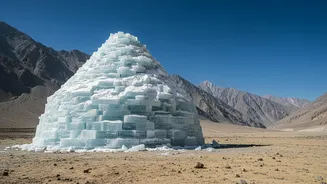
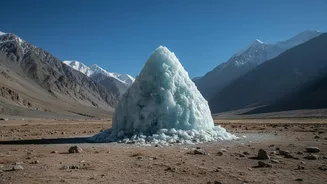
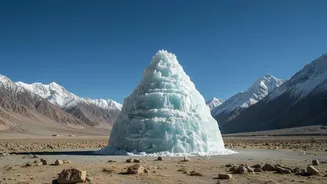
The mechanics of an ice stupa are ingeniously simple and use basic principles of gravity and temperature. During the coldest winter months, when water from upstream rivers would otherwise go to waste, it is diverted through a network of pipes. The pipes run to a lower altitude, and the natural drop creates pressure. This pressure forces the water up through a vertical pipe, from which it sprays out like a fountain. In the sub-zero Ladakhi air, which can drop below -20°C, the water freezes almost instantly as it falls, gradually building up a massive, conical mountain of ice. These structures are named 'stupas' for their resemblance to traditional Buddhist monuments that dot the Ladakhi landscape.
A Lifeline for Spring
The true genius of the ice stupa becomes apparent in the spring. Because of its conical shape, the artificial glacier melts slowly and steadily, releasing water from April through June. This is precisely the period when farmers desperately need it to irrigate their newly planted fields. The first prototype, built in 2013, stored 150,000 litres of water and lasted until mid-May, proving the concept's viability. Since then, dozens of ice stupas have been built across Ladakh, some storing millions of litres of water each. This stored winter water bridges the dangerous gap between the early sowing season and the late arrival of natural glacial melt, providing a crucial lifeline for the region's agriculture.
More Than Just Water
The ice stupa project, led by Wangchuk's NGO SECMOL, has become more than just an engineering solution. It has evolved into a community-driven movement that empowers local villages and promotes ecological awareness. The projects are often funded through crowdfunding and are built by villagers themselves, fostering a sense of ownership. Ice stupa building competitions have been held to encourage wider adoption of the technique. These frozen towers have become powerful symbols of climate adaptation and resilience, attracting tourists and inspiring similar projects in other mountain regions around the world, including Switzerland. They stand as a testament to how local, low-cost innovation can provide hopeful answers to some of our most pressing global challenges.