




Mark Your Calendar: Prime Viewing Time
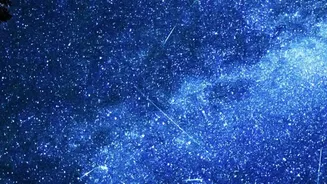
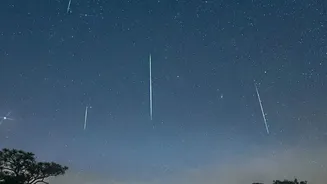
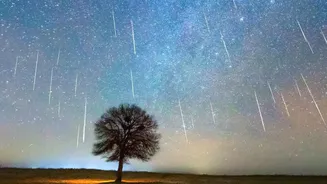
The Orionid meteor shower will be active from early October to early November, but the best time to watch will be at its peak on the night of October 21-22, 2026. The show is courtesy of debris left behind by the famous Halley's Comet. Observers in both
the Northern and Southern Hemispheres can enjoy the spectacle. For the best views, plan to be outside in the hours between midnight and dawn. In 2026, a bright waxing gibbous moon will be present during the peak, so the ideal window for watching will be after the moon sets, which is around 3 a.m. local time. In a dark location, you can expect to see around 15 to 20 meteors per hour.
The Science of Seeing in the Dark
The central piece of advice for any meteor shower is to allow your eyes to fully adapt to the darkness, a process that can take 20 to 30 minutes. Your eyes have two types of photoreceptor cells: cones for colour and detail in bright light, and rods for low-light vision. When you move into a dark environment, your pupils dilate quickly, but the real work is done by a chemical called rhodopsin in your rod cells, which slowly regenerates to make your eyes far more sensitive to faint light. This is why stars seem to slowly appear out of nowhere the longer you are outside. Even a quick glance at a bright phone screen can instantly destroy your night vision, as the blue-hued light breaks down the rhodopsin you've patiently built up, forcing you to start the 20-minute adaptation process all over again.
What to Do Instead of Scrolling
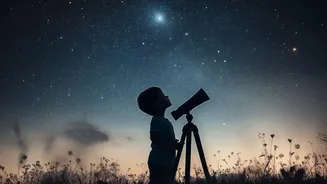
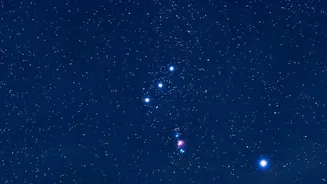
Resisting the urge to check your phone is crucial. If you need a light source, use a flashlight covered with a red filter or one with a dedicated red-light mode. Red light has a longer wavelength and is less damaging to your night vision. You don't need a telescope or binoculars; the naked eye is best for meteor watching because it allows you to see a much wider patch of sky. Instead of staring at the radiant point in the constellation Orion, look about 45 degrees away from it. The meteors will appear longer and more dramatic from this perspective. The best thing to do is simply lie back, look up at the darkest part of the sky you can find, and be patient. The show will come to you.
Gear Up for a Comfortable Watch
You will be sitting or lying still for a long time, and even on mild nights, it can get chilly in the predawn hours. Comfort is key to ensuring you stay out long enough to enjoy the peak activity. Pack a reclining chair or a thick blanket to lie on. Bringing an extra sleeping bag or warm blankets is a great idea to stay cozy. A thermos with a warm drink like tea or hot chocolate can also make the experience more pleasant. Don't forget bug spray, just in case. The goal is to get so comfortable that you can forget about everything else and just focus on the cosmic display above.
A Connection to a Famous Comet
As you watch the sky, it is worth remembering what you are seeing. Each streak of light is a tiny piece of rock or dust, often no bigger than a grain of sand, shed by Halley's Comet on one of its ancient journeys through the inner solar system. This famous comet, which takes about 76 years to orbit the sun, last passed by Earth in 1986 and will not return until 2061. The Orionids are what happen when Earth passes through this stream of dusty debris. In a very real sense, watching the Orionid meteor shower is a way of connecting with one of the most storied objects in our solar system's history.