



A New Geometric Marvel
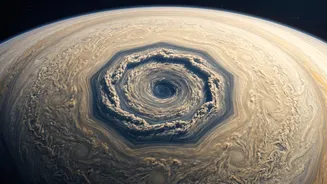
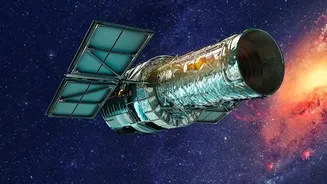
In a discovery that reshapes our understanding of the gas giant, astronomers using NASA's Hubble Space Telescope have confirmed the existence of a massive, 10-sided atmospheric wave encircling Saturn's south pole. This feature, dubbed a decagon, is the first
large, regular-sided jet stream pattern ever observed in the planet's southern hemisphere. The discovery, published in the journal Science Advances, provides a stunning counterpart to the planet's famous northern hexagon, proving that Saturn's atmospheric dynamics are even more complex and mysterious than previously believed. The images from Hubble show a distinct, ten-sided structure embedded within a powerful jet stream, offering a clear view of a phenomenon that has only recently taken shape.
A Sibling to the Famous Hexagon?
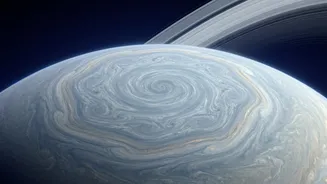
For over four decades, Saturn's most peculiar feature has been its northern hexagon, a six-sided jet stream wider than planet Earth, first spotted by the Voyager spacecraft in the 1980s. This persistent, strangely geometric storm has puzzled scientists, who have simulated similar shapes in labs but have struggled to explain its perfect and long-lasting formation on a planet. For years, it was thought to be a one-of-a-kind wonder. The Cassini spacecraft, which orbited Saturn from 2004 to 2017, extensively studied the hexagon but found no similar long-lived structure at the south pole, which was then dominated by a more conventional circular vortex. This led many to believe the hexagon was a unique anomaly, making the sudden appearance of a southern decagon a complete surprise.
Similar, But Strikingly Different
While the decagon invites immediate comparison to its northern sibling, it has its own distinct personality. For one, it is significantly larger. But the most crucial difference lies in its behavior. The northern hexagon is remarkably stationary, locked in place over the pole. In contrast, the southern decagon appears to be a more dynamic 'meandering wave' that drifts eastward. Scientists theorize this movement suggests it's a different kind of atmospheric phenomenon, one that penetrates deep into Saturn's atmospheric layers. Its corners seem to oscillate back and forth, making it less of a fixed object and more of a propagating wave pattern within a jet stream racing at over 400 kilometers per hour.
A Recently Formed Mystery
Perhaps the most fascinating aspect of the decagon is its recent birth. By analyzing years of data from Hubble's Outer Planet Atmospheres Legacy (OPAL) program, researchers traced its emergence. Faint hints of the structure first appeared in images from 2023, with the shape becoming much more defined through 2024 and 2025. The fact that it wasn't there during Cassini's thirteen-year mission, which ended in 2017, proves that giant planets are not the static, unchanging worlds they can sometimes appear to be. This raises a critical question: why now? One hypothesis suggests its formation could be linked to a nearby high-pressure vortex, an anticyclone that may have perturbed the jet stream and forced it into this 10-sided pattern.