


Webb's Anniversary Gift: A Galactic Crash
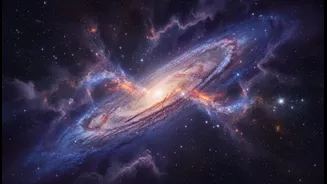
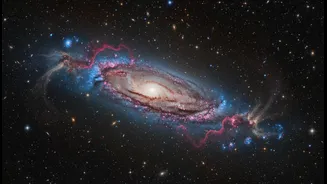
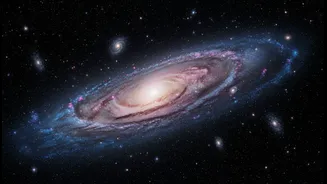
To celebrate the fourth anniversary of its science operations, the James Webb Space Telescope (JWST) has delivered a stunning new view of Centaurus A. Located a relatively close 11 million light-years away, this galaxy is a chaotic and beautiful mess,
the result of a collision between two galaxies billions of years ago. Where the Hubble telescope saw only obscuring lanes of dust, Webb's powerful infrared vision cuts through the gloom, revealing a densely packed tapestry of millions of individual stars. This unprecedented clarity allows astronomers to perform a kind of galactic archaeology, studying the history of this active and mysterious galaxy star by star. The image is not just a pretty picture; it is a laboratory for understanding how galaxies and the supermassive black holes at their cores grow and evolve together.
Euclid Finds the Oldest Quasars
Meanwhile, the European Space Agency's (ESA) Euclid space telescope has been peering into the dawn of time, discovering 31 of the most ancient quasars ever documented. Quasars are the intensely bright cores of distant galaxies, powered by supermassive black holes feeding on surrounding gas and dust. These forces generate more light than all the stars in the galaxy combined. Two of the newly found quasars are the oldest ever seen, dating back to when the universe was just 5% of its current age, their light having travelled for 13 billion years to reach us. This discovery more than doubles the number of known quasars from this early epoch, giving scientists a vital tool to probe the distribution of dark matter and understand how the very first galaxies and black holes formed.
Cosmic Fireworks in FS Tau
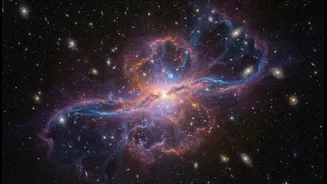
In a spectacular display of cosmic fireworks, the JWST also released a new image of the FS Tau region. This image captures infant stars, or "protostars," as they burst forth from the molecular clouds where they were born. The stunning detail reveals gaps and outflows of gas, which supports the theory that young stars gather material in distinct, episodic bursts rather than a continuous flow. The bright blue ridges visible in the image are gas and dust that have been pushed aside by these powerful outflows, creating a scene that rivals any terrestrial fireworks display. NASA released the image in early July to celebrate the 250th anniversary of the United States, a fitting tribute to independence on a cosmic scale.
The Dragons of Ara
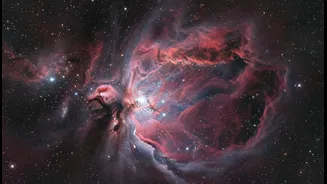
Not to be outdone, NASA's Astronomy Picture of the Day for July 7, 2026, featured a breathtaking view of NGC 6188, a nebula nicknamed the "Dragons of Ara." Located about 4,000 light-years away in the southern constellation of Ara (the Altar), these celestial dragons are not mythical beasts, but fantastical shapes sculpted from gas and dust. The powerful stellar winds and intense radiation from massive young stars, formed only a few million years ago, have carved out the dark, twisting shapes and cause the surrounding nebula to glow. The wide-field image, captured from Australia, showcases the immense scale and intricate detail of this star-forming region, reminding us that the universe is filled with art as well as science.