





The Great Water Escape
At its core, almost all food is composed of a significant amount of water. Crispiness is what happens when we convince that water to leave, especially from the surface. Think of cooking as a race: you need to drive moisture out to create a dry, rigid
structure before the food overcooks or burns. When you put food into hot oil or a hot oven, the surface water is the first to go, turning into steam and escaping into the air. This rapid dehydration leaves behind a network of tiny, empty pockets in the food's structure. It is this porous, brittle framework that we perceive as 'crisp' when we take a bite. The characteristic crackle and snap are the sounds of this delicate structure breaking. Without this mass exodus of water, you get a soft, flexible texture instead of a crunchy one.
A Shorter Journey to Freedom
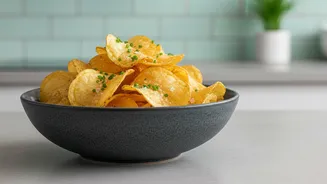
This is where the headline's wisdom comes into play. For a water molecule trapped inside a food item, the journey to the surface is a crucial factor. In a very thin item, like a potato cut for a wafer or a finely sliced vegetable, that journey is incredibly short. As soon as heat is applied, the water from the very centre of the food has only a tiny distance to travel before it can evaporate. In a thick piece of food, like a steak-cut fry or a dense chunk of paneer, water molecules from the interior have a much longer, more difficult path to the surface. By the time they get there, the outer layers might already be cooked. This difference in travel distance is the fundamental reason why thin items dehydrate and crisp up so much more efficiently.
The Magic of a Dry Surface
Getting the surface dry quickly is critical for another reason: it unlocks the delicious chemistry of browning. The famous Maillard reaction—the process responsible for the savoury, complex flavours of seared meat, toasted bread, and fried snacks—can only happen in a dry, high-heat environment. This reaction, a chemical dance between amino acids and sugars, kicks off around 140°C. However, as long as liquid water is present on the surface of the food, the temperature is capped at water's boiling point (100°C), which is too low for the Maillard reaction to occur. Because thin foods expel their moisture so quickly, their surfaces can rapidly exceed 100°C, allowing those beautiful browning reactions to begin, creating deep flavour and a golden-brown colour.
Surface Area and Heat Transfer
Thinness also dramatically changes a food's surface-area-to-volume ratio. A thin, flat object has a massive amount of surface area relative to its small internal volume. This means it can absorb heat from the pan or oven much more rapidly and evenly. A thick item, by contrast, has a lot of internal volume protected from the direct heat source. Heat must slowly travel from the outside in, a process known as conduction, which is much slower in food than in a metal pan. This is why a thick steak can have a perfect crust on the outside while remaining rare in the middle, while a smash burger, being thin, cooks through almost instantly, developing an all-over crust.
Putting the Science into Practice
Understanding this principle can make you a better cook. It explains why shoestring fries are almost entirely crisp, while steak fries have a soft, fluffy interior. It’s why a thin-crust pizza develops a cracker-like base, and why 'smashed' potatoes with their many thin, flattened edges get far crispier in the oven than a perfectly whole roasted potato. When you want maximum crunch, you should aim to maximise surface area and minimise the distance moisture needs to travel. Slicing vegetables thinly before roasting, patting meat completely dry before searing, and not overcrowding the pan—which traps steam and lowers temperature—are all practical ways to apply this science in your own kitchen.