




First, Let’s Define a Year
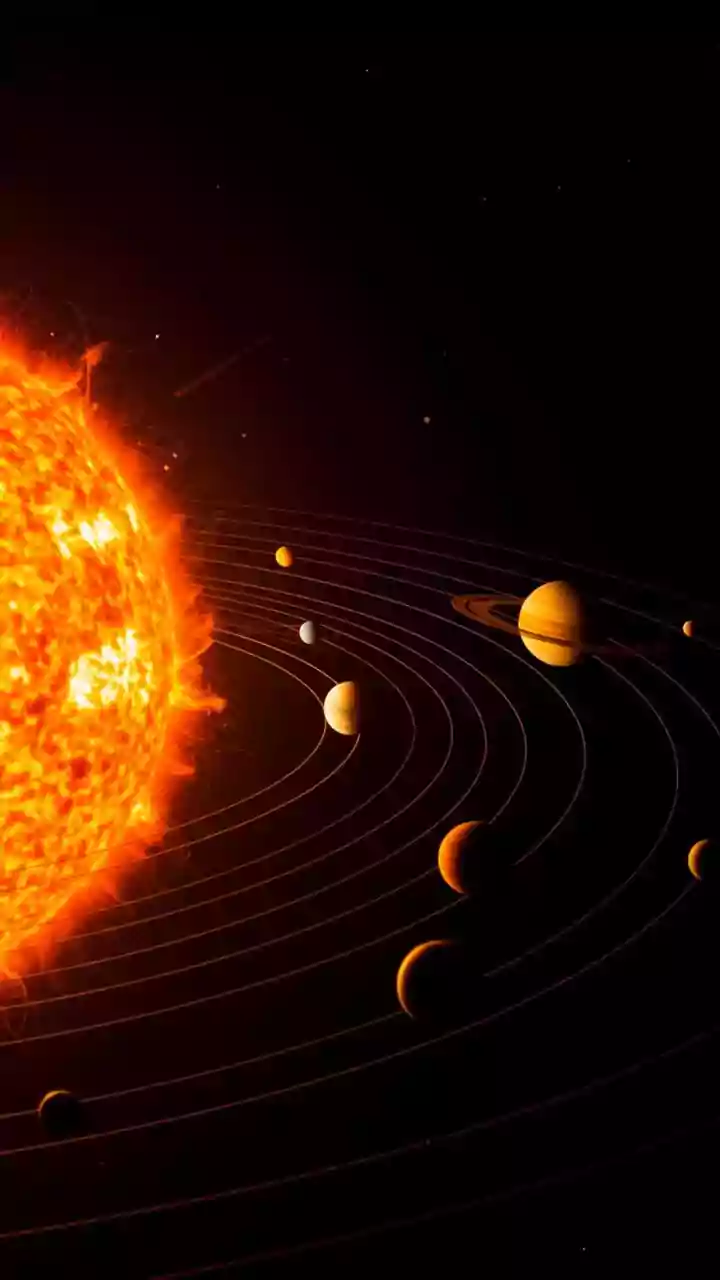
Before we get to its incredibly long day, let’s start with the easy part: a Venusian year. Just like on Earth, a year is defined by the time it takes for a planet to complete one full orbit around the Sun. Earth takes approximately 365 days to make this
journey. Venus, being the second planet from the Sun, has a shorter path to travel. It zips around our star in just under 225 Earth days. So, if you were to celebrate birthdays on Venus, they would come around much faster. A 40-year-old on Earth would be celebrating their 65th birthday on Venus. It’s a simple concept: a shorter orbit means a shorter year.
The Incredibly Long Day
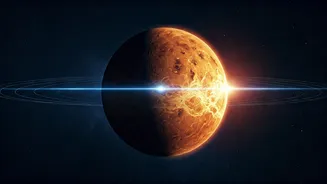
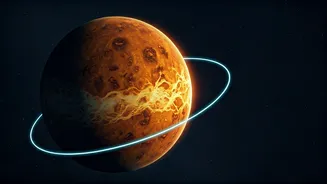
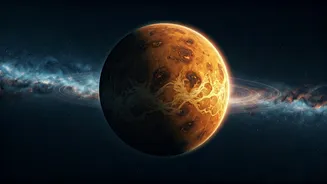
Now for the tricky part: the day. A planet’s day is determined by its rotational speed—how long it takes to spin once on its axis. Earth does this in about 24 hours. Venus, however, is the laziest spinner in our solar system. It rotates incredibly slowly, taking a staggering 243 Earth days to complete a single turn. This is what creates the cosmic oddity: its day (243 Earth days) is longer than its year (225 Earth days). You could start a day on Venus, watch it complete an entire orbit around the Sun, and still be waiting for the same day to end. It's a mind-bending reality that makes Venus one of the strangest worlds we know of.
A Day That Lasts 117 Earth Days?
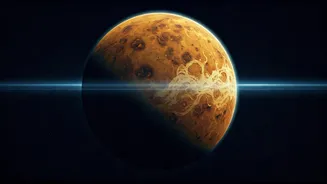
To add another layer of weirdness, the time from one sunrise to the next on Venus—what we call a solar day—is different. While Venus takes 243 Earth days to spin once on its axis (a sidereal day), it also spins backwards, a phenomenon known as retrograde rotation. On Venus, the sun rises in the west and sets in the east. This backward spin, combined with its orbit around the sun, means that the time from one sunrise to the next is actually shorter than its rotational period. A solar day on Venus lasts about 117 Earth days. So, while a single rotation is longer than a year, you would experience two sunrises and two sunsets in a single Venusian *year*. It’s a confusing but fascinating piece of celestial mechanics.
Why the Bizarre Rotation?
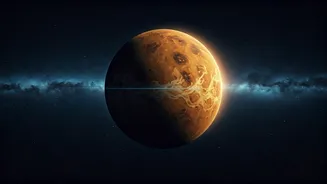
Scientists aren't entirely sure why Venus spins so slowly and in the wrong direction. The leading theory suggests that billions of years ago, a massive planet-sized object slammed into Venus, altering its spin and effectively flipping it upside down. Its north pole is where its south pole should be. Another compelling theory involves Venus’s incredibly thick and heavy atmosphere—about 92 times denser than Earth’s. This dense atmosphere may have created powerful tidal forces over billions of years, acting like a brake and gradually slowing the planet’s rotation to its current crawl. It’s possible a combination of both a past collision and atmospheric drag contributed to the strange calendar Venus keeps today.
Earth’s Hellish Twin
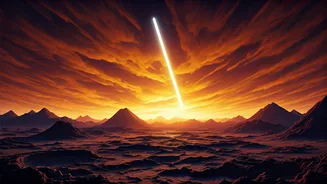
This long, strange day is spent in an environment that is anything but pleasant. Often called Earth's "evil twin" due to its similar size and mass, Venus is a hellscape. The surface temperature is a blistering 465°C, hot enough to melt lead. The atmospheric pressure is crushing, equivalent to being 900 metres deep in Earth’s oceans. And its thick clouds aren’t made of water vapour, but of corrosive sulfuric acid. This runaway greenhouse effect traps heat, making Venus the hottest planet in the solar system, even hotter than Mercury, which is closer to the Sun. So, while the idea of a day lasting longer than a year is a fun cosmic fact, spending that day on Venus would be a truly terrifying experience.