







The Royal Dancer in the Rain
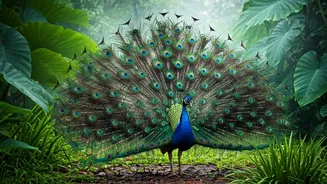
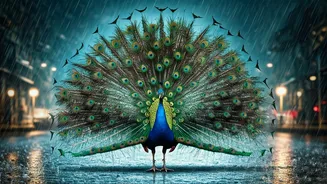
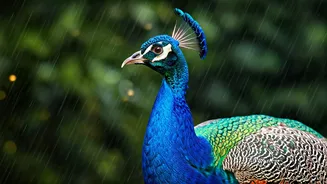
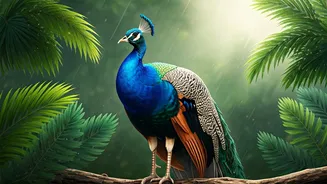
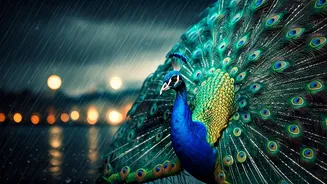
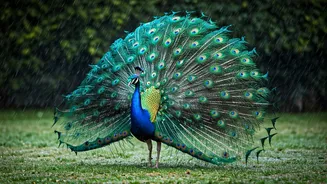
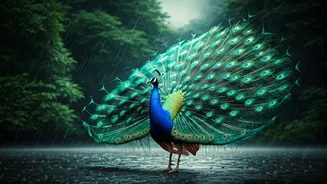
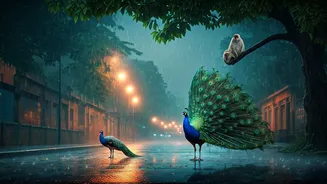
When dark clouds gather, a familiar and spectacular drama unfolds across India. The Indian Peafowl, our national bird, puts on its most famous show. The male, with its iridescent blue neck and crown, raises its spectacular train of covert feathers into
a shimmering fan of greens and golds, dotted with mesmerising eyespots. This magnificent display, often called the peacock’s dance, is deeply embedded in our cultural consciousness as a celebration of the rain. Folk wisdom has long held that this dance beckons the monsoon. While the sight is indeed linked to the season, the motivation is courtship. The monsoon coincides with the peafowl’s breeding season, and the male's elaborate performance is a ritual to attract a mate. This serendipitous timing has woven the peacock's dance into the very fabric of the monsoon experience, a symbol of joy and renewal. Its significance runs deep in mythology, from being the vahana of Lord Kartikeya to its feather adorning Lord Krishna’s crown, cementing its place as a divine and cherished icon of the subcontinent.
The Legendary Harbinger
Long before weather forecasts, another bird served as the most trusted herald of the coming rains: the Jacobin Cuckoo. Known in folklore as the Chatak, this slender, black-and-white crested bird is a celebrated figure in poetry and myth. Legends say it thirsts only for raindrops and that its arrival guarantees the monsoon is not far behind. The great poet Kalidasa used the Chatak in his epic ‘Meghaduta’ as a powerful metaphor for intense longing. Modern science confirms the basis of this age-old observation. The Jacobin Cuckoo is a partial migrant, with some populations undertaking an incredible journey from Africa, riding the same large-scale wind systems that bring the monsoon to India. So, while the bird doesn't predict the weather, its arrival is a direct consequence of the same atmospheric changes, a fellow traveller on the monsoon winds. Its piercing ‘piu-piu’ call becomes a defining sound of the season, a promise of life-giving rain.
A Chorus from the Canopy
Beyond the peacock and the cuckoo, the monsoon awakens a symphony of avian activity. The Baya Weaver bird is another iconic presence. During this season, the male dons a brilliant yellow breeding plumage and becomes a master architect, weaving intricate, pendant-like nests from grass and strips of palm fronds in a tireless effort to impress a mate. In the dense forests of the Western Ghats, the Sholakili, or Nilgiri Shortwing, is famed for its beautiful, melodic song that seems to become even sweeter during a downpour. The air fills with the calls of many other species that are especially vocal during their breeding season. You might hear the sharp notes of the Painted Francolin, see the flash of an Indian Paradise Flycatcher with its ribbon-like tail, or hear the distinctive whistle of the Malabar Whistling Thrush, often called the 'whistling schoolboy'. This explosion of sound and colour transforms the landscape, making any walk in the woods a vibrant, living concert.
The Rhythm of Renewal
The magic we feel is no accident; it is rooted in the fundamental rhythm of life. The monsoon is the primary breeding season for a vast number of India’s resident birds, and for good reason. The rains trigger a population boom among insects like termites, caterpillars, and grasshoppers. This abundance of protein-rich food is exactly what growing chicks need to survive and thrive. The once-dry and dormant landscape bursts into lush green, providing ample cover and materials for birds to build their nests, from the simple cup of a bulbul to the complex fortress of a weaver. The birds we see and hear are responding to this ancient ecological clock. Their songs are territorial claims and courtship calls, their flurry of activity is the urgent business of raising the next generation. The 'magic' is a perfectly timed strategy for survival, a testament to nature’s intricate and resilient design.