



A New Window on the Universe
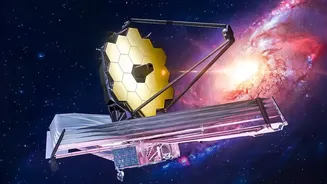
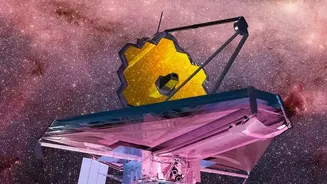
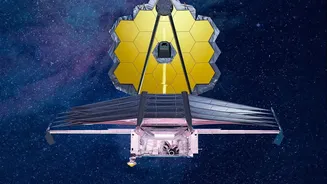
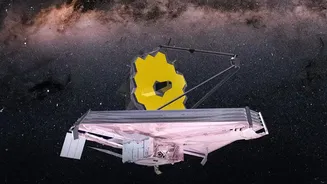
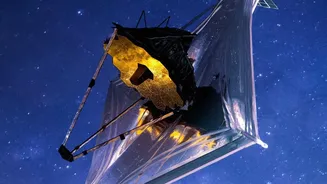
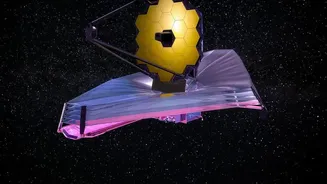
The James Webb Space Telescope (JWST) is the most powerful space observatory ever built, designed to see the universe in a way its predecessors, like the Hubble Space Telescope, could not. Its power lies in its ability to detect infrared light. This is crucial
because the light from the most distant objects in the universe gets stretched into longer, redder wavelengths as it travels across space. Furthermore, infrared vision allows JWST to peer through the dense clouds of cosmic gas and dust that would otherwise obscure our view of stellar nurseries and the birth of planets. It’s this specific capability that made the recent discovery of water possible.
A Star System in the Making
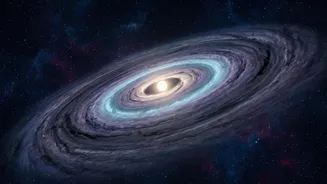
The specific target of this groundbreaking observation was a star system known as PDS 70, located about 370 light-years away. This system is particularly interesting to astronomers because it is young and still in the process of forming planets. It has a vast, swirling disc of gas and dust, known as a protoplanetary disc, which is the raw material for building new worlds. JWST’s MIRI (Mid-Infrared Instrument) was pointed at the inner region of this disc, the very zone where rocky, Earth-like planets are expected to assemble. Previous telescopes had studied this system, but none had the sensitivity to make a detection of this kind in this critical planet-forming region.
Reading the Barcode of Light
So, how can scientists be sure they are seeing water from so far away? The technique is called spectroscopy. When starlight passes through a planet's atmosphere or a disc of gas, different molecules absorb specific wavelengths, or colours, of light. Each molecule has a unique absorption pattern, like a chemical barcode. By capturing the light that has passed through the PDS 70 disc and splitting it into a spectrum, scientists could see the unmistakable signature of water vapour. The data showed clear emission lines that perfectly matched the known barcode for H2O, providing the first direct evidence of water in the terrestrial zone of a disc already known to host developing planets.
Water Where It Matters Most
Finding water in space isn’t entirely new, but finding it in this specific location is a landmark discovery. The water vapour was detected inside the system's 'snowline'—the region warm enough for ice to turn into vapour. Specifically, it was found less than 160 million kilometres from the star, a distance comparable to the zone where Earth orbits our Sun. This implies that any rocky planets forming in this area would have access to a reservoir of water from the very beginning of their existence. This has been a long-standing question in astronomy: does water arrive on planets like Earth from icy comets late in their formation, or is it present from the start? This discovery strongly suggests the latter is possible.
From Vapour to Worlds
The presence of water is considered a key prerequisite for life as we know it. While the discovery in PDS 70 is of water vapour, not liquid oceans, its existence in the planet-forming disk is a crucial first step. It means the essential building blocks for a habitable world are present at the right time and in the right place. Scientists are now investigating how this water survived so close to its star, where radiation would typically break it down. One theory is that dust particles in the disk act as a protective shield. Whatever the mechanism, this finding provides a thrilling new insight into how water, and perhaps life, might get its start across the galaxy.