




A 'New' Star in the Night Sky
Sometime between now and September 2024, a new point of light is expected to appear in our night sky. This isn't science fiction; it's a predictable, albeit rare, cosmic event. The star responsible is T Coronae Borealis (T CrB), a system located about
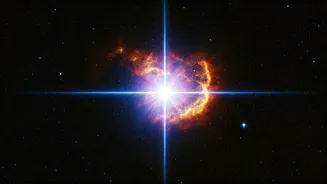
3,000 light-years from Earth. Normally, it’s far too dim to see without a powerful telescope. But for a few precious days, it will flare up so intensely that it will become as bright as the North Star (Polaris, or Dhruva Tara) and easily visible to the naked eye. This phenomenon is known as a recurrent nova. T CrB, nicknamed the 'Blaze Star', last put on this show in 1946, and before that in 1866. Its 80-year cycle means this is a true once-in-a-lifetime opportunity for most of us to witness a star 'exploding' without any special equipment.
The Cosmic Dance of Two Stars
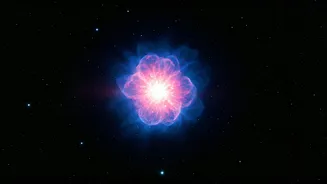
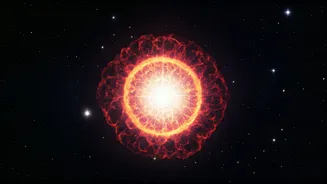
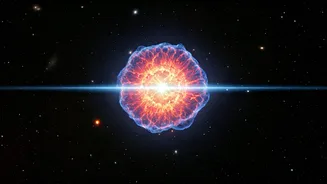
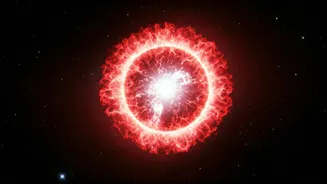
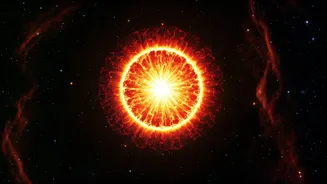
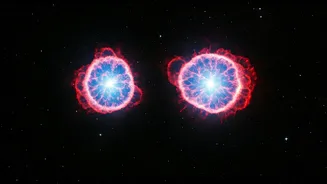
So, what causes this spectacular outburst? T CrB is not a single star but a binary system—a cosmic pair engaged in a dramatic dance. The duo consists of a white dwarf and a much larger red giant. A white dwarf is the super-dense, collapsed core of a star that has run out of fuel, like our sun will be billions of years from now. Its red giant companion is an aging star that has swelled up, its outer layers of hydrogen gas held loosely by gravity. The intense gravitational pull of the compact white dwarf siphons this hydrogen from the red giant. Think of the white dwarf as a cosmic thief, steadily accumulating a layer of stolen material on its surface. When enough hydrogen has piled up and the pressure and temperature at the bottom of this layer reach a critical point, it triggers a runaway thermonuclear explosion. This is the nova. It's a surface-level blast, not one that destroys the star, which is why it can repeat the process.
When and Where to Look
The exact timing of the nova is unpredictable, which adds to the excitement. Astronomers are monitoring T CrB closely, and the eruption could happen any night. The best estimates place the event between now and late September 2024. When it happens, the nova will be visible in the constellation Corona Borealis, also known as the Northern Crown. This is a small, C-shaped arc of stars located between the larger and more prominent constellations of Boötes (the Herdsman) and Hercules. For observers in India, this constellation is well-placed in the northern sky during the evening hours throughout the summer months. The nova will appear as a 'new' star within this familiar pattern, shining brightly for a few days before it begins to fade back into obscurity over the following weeks.
Your Guide to Spotting the Nova
You don't need to be an expert to see this. First, find a location with as little light pollution as possible. While the nova will be bright, city haze and streetlights will make it harder to spot. Give your eyes about 20 minutes to adjust to the darkness. To find the Northern Crown, you can use a stargazing app on your phone—Stellarium, SkyView, or Star Walk are excellent choices. Simply search for 'Corona Borealis'. Once you've located the constellation, look for a new, bright star that wasn't there before. Its brightness will rival that of the stars in the Big Dipper (Saptarishi). While you won't need a telescope, a pair of binoculars will provide a more detailed view and help you appreciate the sudden arrival of this guest star. Remember to check astronomy news sites or social media, as the global community of sky-watchers will be buzzing the moment the eruption is confirmed.
Why This Is a Big Deal
Beyond the sheer spectacle, the T CrB nova is a significant event for scientists. Recurrent novae are cosmic laboratories that allow astronomers to study the process of accretion—how matter is transferred between stars. Each explosion provides a wealth of data that helps refine our understanding of stellar physics and the life cycles of stars. By observing the event across the entire light spectrum, from radio waves to gamma rays, scientists can test their models of thermonuclear reactions. Instruments like the James Webb Space Telescope may even turn their gaze toward the fading aftermath of the nova to study the material ejected into space. It's a rare chance to study a process that is a precursor to a much more violent event, the Type Ia supernova, which is used by cosmologists as a 'standard candle' to measure the expansion of the universe.