
Seeing the Universe in Infrared
Much of the cosmos is hidden from human eyes. Stars and planets form inside thick clouds of dust and gas that visible light cannot penetrate. To see what’s inside, astronomers turn to infrared light. Often associated with heat, infrared is a range of light that is invisible
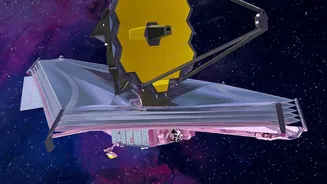
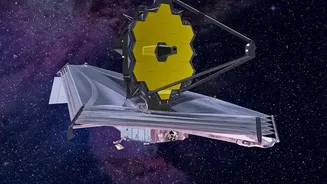
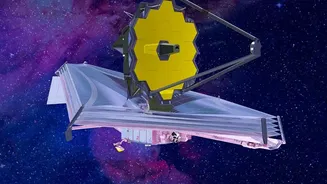
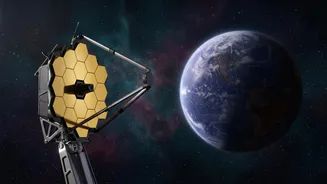
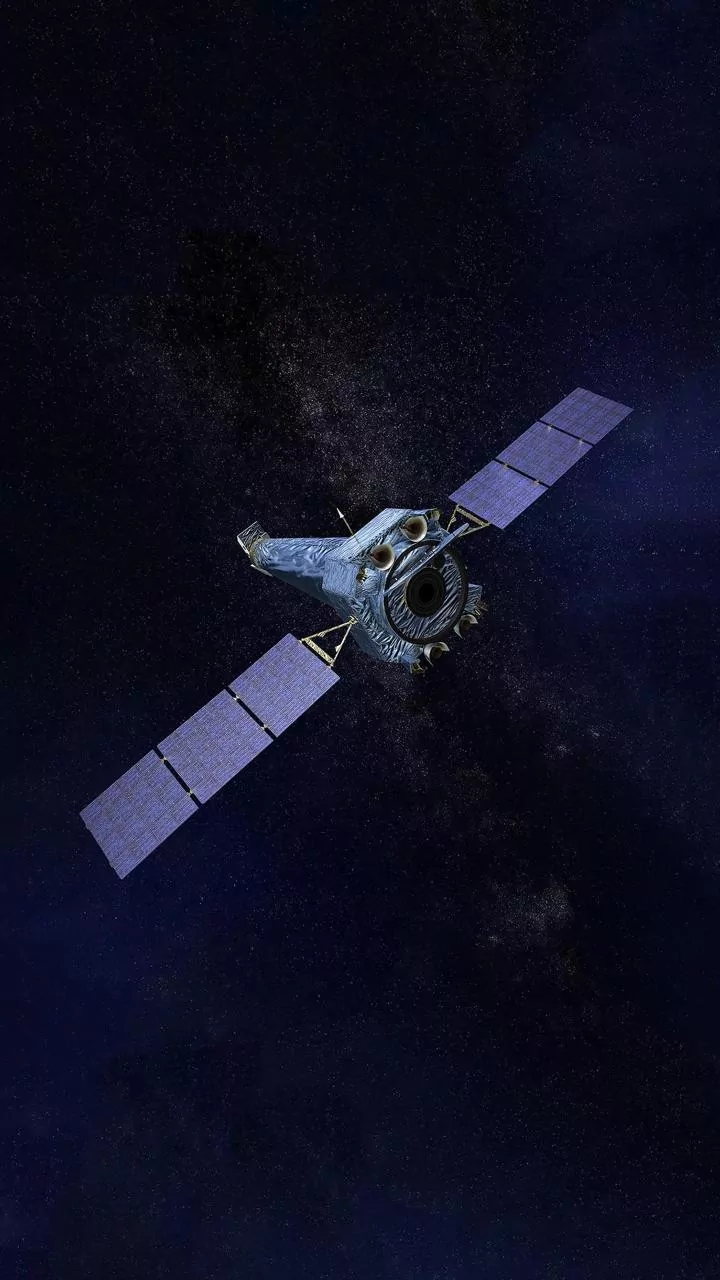
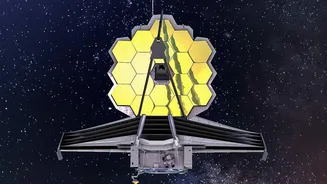
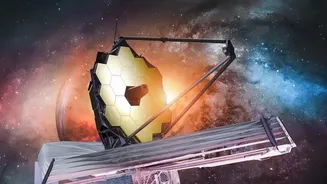
to us but can pass through these cosmic clouds. The James Webb Space Telescope is designed specifically to capture this light. Its giant, gold-coated mirror and advanced instruments are cooled to incredibly low temperatures—as cold as minus 266 degrees Celsius for its Mid-Infrared Instrument (MIRI)—to prevent the telescope's own heat from interfering with the faint signals from deep space. This allows it to see everything from the earliest galaxies to the atmospheres of planets orbiting other stars.
Water’s Unique Chemical Fingerprint
The key to finding water is knowing what to look for. Every molecule absorbs specific colors, or wavelengths, of light while letting others pass. For water (H2O), this pattern is most prominent in the infrared spectrum. When light passes through a gas containing water vapor, the water molecules absorb very particular infrared wavelengths, leaving gaps in the light that reaches a telescope. This creates a unique chemical signature, much like a barcode. By analyzing the light from a distant star system, astronomers can look for this specific 'water barcode' to determine if water is present. Webb's instruments are finely tuned to spot these tell-tale signs.
Using Starlight as a Cosmic Scanner
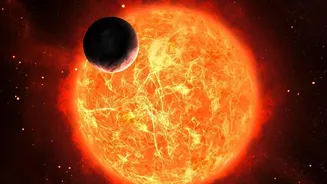
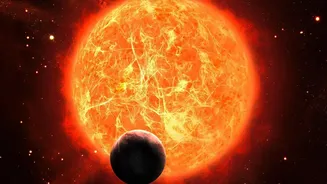
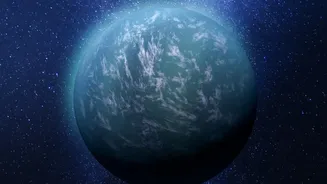
Webb doesn't look for water directly on the surface of an exoplanet. Instead, it uses a clever technique called transit spectroscopy. Astronomers wait for a planet to pass in front of its host star from our point of view, an event known as a transit. As the planet crosses, a tiny fraction of the starlight filters through the planet's atmosphere before continuing its journey to Webb's mirrors. This starlight carries with it the chemical imprints of whatever gases are in that atmosphere. By capturing and analyzing this light, the telescope can effectively 'scan' the planet's air for different molecules, including water.
The High-Tech Toolkit for Analysis
This detailed analysis is performed by Webb’s suite of spectrographs, particularly the Near-Infrared Spectrograph (NIRSpec) and the Mid-Infrared Instrument (MIRI). These aren't cameras that take a simple picture; they are advanced tools that spread the incoming light into a full spectrum of wavelengths, similar to how a prism creates a rainbow. The resulting data, called a transmission spectrum, is a graph showing the brightness of light at thousands of precise wavelengths. When a molecule like water is present in the exoplanet's atmosphere, it blocks some of the starlight, causing a noticeable dip in the graph at specific infrared wavelengths. Seeing these characteristic dips is how scientists confirm the presence of water vapor.
From Water Vapor to Habitability
Finding water vapor is a critical first step, but it’s not the end of the story. The same infrared technology allows scientists to search for other important molecules that could signal a planet’s potential for life, such as methane, carbon dioxide, and even sulfur dioxide. By combining data on all these atmospheric components, researchers can begin to build a complete picture of an exoplanet's environment. Recent Webb discoveries, like the detection of water on the exoplanet WASP-96 b or in the atmosphere of GJ 486 b, showcase the power of this technology. It's helping astronomers understand not just if a planet has water, but also its climate and potential for supporting life as we know it.