
The Challenge of Seeing Alien Worlds
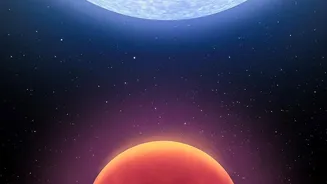
Studying planets outside our solar system, known as exoplanets, presents an immense challenge. They are incredibly distant, small, and faint. Most are completely overwhelmed by the brilliant light of the stars they orbit, making them virtually impossible
to photograph directly. To overcome this, scientists don't look for the planet itself, but for the subtle ways it affects the light from its parent star. This has led to the development of ingenious methods that turn powerful telescopes into long-range weather stations.
The Power of Invisible Light
The key to unlocking exoplanet weather lies in a type of light our eyes can't see: infrared. While a star's overwhelming glare is most prominent in visible light, hot planets and their atmospheres actually glow in the infrared spectrum. Telescopes like the James Webb Space Telescope (JWST) are designed specifically to be sensitive to this infrared light. By focusing on these wavelengths, astronomers can filter out the stellar noise and isolate the faint signals coming from the planet itself, giving them the raw data needed to probe its atmospheric secrets.
Decoding the Light with Spectroscopy
The primary technique for reading these signals is called transmission spectroscopy. As an exoplanet passes in front of its star—an event called a 'transit'—a tiny fraction of the starlight filters through the planet’s atmosphere. Different chemical elements and molecules in that atmosphere absorb specific wavelengths, or colors, of light. This process leaves a unique chemical 'barcode' imprinted on the starlight that reaches our telescopes. By analyzing this barcode, scientists can identify the atmospheric composition, detecting elements like water vapor, carbon dioxide, or even vaporized metals.
Case Study: Raining Iron on WASP-76b
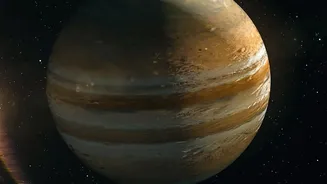
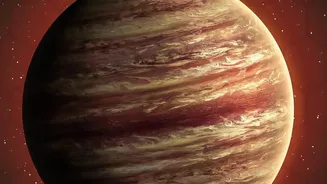
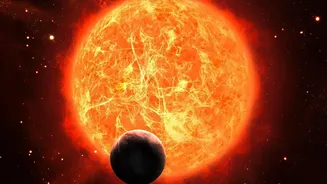
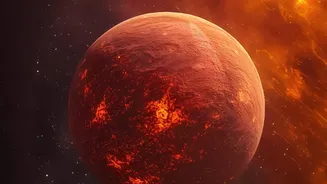
A dramatic example of this technique in action is the exoplanet WASP-76b, a 'hot Jupiter' located about 640 light-years away. This giant planet is tidally locked, meaning one side perpetually faces its star while the other remains in permanent darkness. The dayside temperature soars above 2,400°C, hot enough to vaporize iron. Using spectroscopy, astronomers detected a strong signature of iron vapor on the planet's scorching 'evening' edge, where the atmosphere rotates from day to night. However, that iron signature was mysteriously absent on the 'morning' side. The conclusion was astonishing: powerful winds carry the iron vapor to the cooler nightside (around 1,500°C), where it condenses into liquid droplets and falls as iron rain.
From Barcodes to Weather Maps
Scientists can go even further, creating actual weather maps of these distant worlds. By continuously measuring the infrared brightness of a star-planet system as the planet completes its orbit, a technique known as phase curve analysis, they can map temperature variations across the planet's surface. As the planet rotates, different parts—the hot dayside, the cooler nightside, and the regions in between—come into view, causing tiny fluctuations in the total light detected. These measurements allow astronomers to locate the hottest point on the planet, infer wind speeds that can exceed 5,000 miles per hour, and even map the location of cloud banks.