







A Job Well Done in Orbit
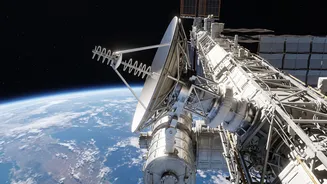
NASA astronaut Anil Menon and European Space Agency (ESA) astronaut Sophie Adenot conducted a spacewalk on Tuesday, August 25, that lasted six and a half hours. Their primary goal was to install a replacement Space-to-Ground Antenna (SGANT), a task essential
for maintaining robust communications with Mission Control in Houston. The spacewalk, officially designated U.S. Spacewalk 98, saw Menon positioned at the end of the Canadarm2 robotic arm while Adenot maneuvered along the station's exterior. Together, they retrieved the spare antenna, mounted it on the Z-1 truss structure, and successfully made the power and data connections needed to bring it online. Initial tests confirmed the new antenna was working, a moment celebrated by a jubilant message from Mission Control: "You just saved the video dish."
The Lifeline to Earth
The Space-to-Ground antennas are a critical lifeline for the International Space Station. Operating in the S-band frequency, these systems are the primary channel for relaying low-rate voice and data between the crew and ground teams. While the station has other communication methods, including higher-bandwidth Ku-band for video, the S-band antennas provide essential redundancy. When one of the aging antenna assemblies stopped working properly last November, the station had to rely on its other unit, removing the safety net of a backup system. This repair mission was not just about fixing a broken part; it was about restoring the station's resilience and ensuring that astronauts always have a reliable connection to Earth for both routine operations and potential emergencies.
Second Time's the Charm
The successful installation on Tuesday was the conclusion of a two-part process. The headline's mention of a previous mission running out of time refers to a spacewalk conducted by the very same astronaut duo just one week earlier, on August 18. During that outing, which lasted over six hours, Menon and Adenot managed to remove the faulty antenna but encountered unexpected delays. Disconnecting stubborn electrical cables and loosening bolts on the old unit took far longer than anticipated. Faced with the strict time limits of a spacewalk, governed by oxygen supply and crew fatigue, flight controllers made the call to postpone the installation of the new antenna. The astronauts safely secured the failed unit to a temporary spot on the station's truss and returned inside, setting the stage for this week's follow-up mission to finish the job.
The High-Stakes World of Spacewalking
Every Extravehicular Activity (EVA), as spacewalks are formally known, is a meticulously planned yet inherently dangerous operation. Astronauts work in a vacuum, tethered to the station, while wearing bulky, pressurized suits that function as personal spacecraft. They face extreme temperature swings, the risk of micrometeoroid debris, and the ever-present danger of suit failure or becoming detached from the structure. The August 25 EVA was the 283rd spacewalk in support of station assembly and maintenance since construction began. For Menon, it was his third career spacewalk, bringing his total time outside to 19 hours and 20 minutes. It marked the second spacewalk for Adenot, who made history during the August 18 EVA by becoming the first French woman to perform one.