


More Than Just Counting Stars
The headline-grabbing idea of a 'star census' isn't about counting stars one by one. Instead, it’s about understanding the big picture of cosmic history. Scientists are using JWST to study how quickly the first stars and galaxies formed after the Big
Bang, a period known as the 'cosmic dawn'. By peering back across more than 13 billion years, the telescope's powerful infrared instruments can detect the light from these first stellar nurseries, which has been stretched to longer wavelengths by the expansion of the universe. This allows astronomers to see through thick veils of cosmic dust and gas that blinded previous telescopes like Hubble, giving us our first clear look at the universe taking its first steps. What JWST is finding is that the lights in the universe switched on much earlier and more brilliantly than our models had predicted.
A Universe Already Busy and Bright
Prior to JWST, the prevailing theory was that the first billion years of the universe were a relatively quiet period of slow and steady galaxy formation. But the telescope has shattered that picture. It has uncovered a surprising abundance of bright, massive galaxies that appear to have formed just a few hundred million years after the Big Bang. These ancient galaxies are not the small, simple structures scientists expected. Instead, many are already complex, showing signs of mergers and interactions far earlier than predicted. In one case, JWST found a tightly packed collision of at least five galaxies from a time when the universe was only 800 million years old, a level of complexity that wasn't thought to be common until much later. This suggests that the process of building large galaxies, like our own Milky Way, got a much faster and more chaotic start than we realised.
Rewriting the Cosmic Timeline
These discoveries are forcing a major rethink of cosmological models. The sheer number and brightness of these early galaxies challenge our understanding of everything from star formation to the evolution of supermassive black holes. One of the biggest puzzles is how these galaxies became so large, so quickly. Theories are now emerging that the earliest stars may have formed more efficiently, or that conditions in the early universe were more conducive to rapid growth. Furthermore, JWST is providing crucial evidence for how the universe escaped its 'cosmic dark ages'. After the Big Bang, the universe was filled with a neutral hydrogen fog that absorbed light. JWST has identified tiny, energetic galaxies that appear to have pumped out enough ultraviolet radiation to ionize this gas, clearing the fog and making the universe transparent.
Closer to Home, Still Astounding
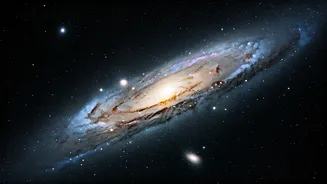
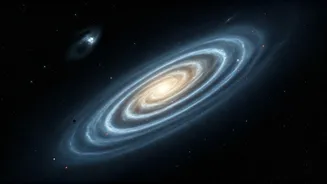
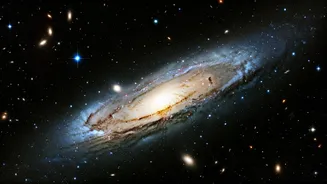
While its discoveries in the deep universe are rewriting textbooks, JWST is also delivering astonishing 'star census' data closer to home. In a recent detailed survey of Messier 82, a 'starburst' galaxy just 12 million light-years away, the telescope was able to individually resolve and identify 16.5 million stars. This galaxy is forming stars about ten times faster than our Milky Way. By penetrating the thick dust that previously obscured our view, JWST provided an unprecedentedly clear look at the interior of a galaxy undergoing a brief, intense phase of its life. These observations are not just about collecting big numbers; they provide a fossil record of how the galaxy formed and evolved, helping scientists understand the mechanics that drive these furious bursts of creation.