




A Familiar, Peculiar Neighbor
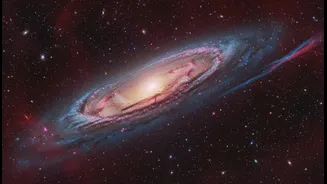
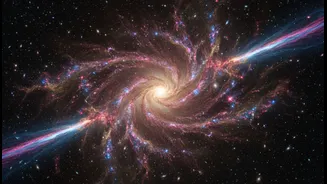
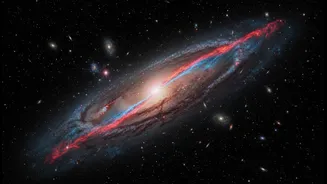
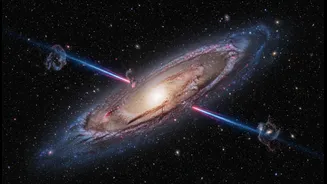
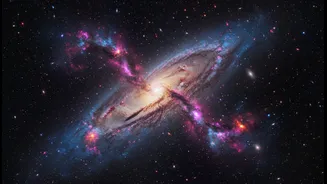
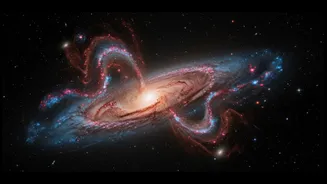
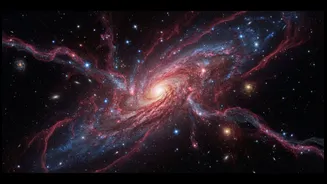
The galaxy in question is Centaurus A, located about 11 million light-years away—a stone's throw in cosmic terms. For decades, astronomers have been fascinated by it. It’s one of the brightest objects in the night sky, but it’s also distinctly odd. Its
strange shape is the result of a violent, head-on collision with another galaxy that happened roughly two billion years ago. This cosmic smash-up left Centaurus A with an abundance of gas and dust, fuelling intense bursts of star formation and feeding the supermassive black hole at its core. This makes it an incredibly active and powerful laboratory for understanding how galaxies evolve, but there has always been a catch: much of the action has been hidden behind a thick veil of cosmic dust.
The Power of Seeing Heat
When we look at space with traditional telescopes like Hubble, we are mostly seeing visible light—the same kind our eyes detect. This view is often blocked by cosmic dust, like trying to see through a thick fog. The James Webb Space Telescope (JWST), however, is a game-changer. It sees the universe in infrared light, which is essentially heat radiation. This longer wavelength of light can pass straight through the dense dust clouds that obscure visible light, allowing us to peer into the heart of galactic nurseries and chaotic cores that were previously invisible. To celebrate its fourth year of science operations, NASA has released breathtaking new images of Centaurus A from the Webb telescope, and they are transforming our understanding of this familiar galaxy.
A Galaxy Laid Bare
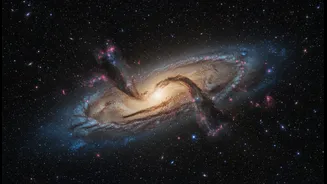
Where previous telescopes saw only dark, obscuring lanes of dust, Webb sees a glowing, intricate tapestry of detail. The new images cut through the galaxy's central dust band to reveal millions of individual stars, packed together like grains of sand. While the retired Spitzer Space Telescope could also see in infrared, it lacked the power to resolve these individual stars and fine structures. Webb’s mid-infrared vision highlights the galaxy’s complex dust structures, which glow in surprising and perplexing shapes. Astronomers have noted a warped, parallelogram-like band and a strange 'S' shaped feature that defy easy explanation and are sparking new questions about the forces at play.
Cosmic Archaeology in Action
This newfound clarity isn't just for pretty pictures; it's a revolutionary tool for science. By being able to see each individual star, astronomers can essentially perform galactic archaeology. Each star holds information about the galaxy's past. Scientists can now begin to reconstruct a detailed timeline of Centaurus A's evolution—pinpointing when bursts of star formation occurred following the ancient collision and how the galaxy has changed over billions of years. We can now see the inner workings of the galaxy, star by star, observing how the central black hole's immense energy output shapes the environment around it and influences the birth of new stars. What was once a familiar but mysterious galaxy has become an open book, its violent history and active present laid bare for the first time.