


An Ideal Time to Look Up
August is an excellent month for observing Saturn as it approaches its annual opposition, which in 2026 occurs on October 4. Opposition is when Earth passes directly between Saturn and the Sun, making the planet appear at its biggest and brightest from
our point of view. In August, Saturn will rise a few hours after sunset and will be well-positioned high in the southern sky for observation after midnight, shining brightly in the constellation Pisces. The planet will be visible to the naked eye, appearing as a bright, steady, yellowish point of light. For those tracking celestial events, watch for the Moon passing close to Saturn overnight from August 30 to 31.
What Equipment Do You Need?
Your viewing experience will vary greatly depending on the equipment you use. With the naked eye, Saturn will look like a bright star. A good pair of binoculars might reveal that the planet is not perfectly round, hinting at its famous rings. To truly see the rings as a distinct structure, however, you will need a telescope. Even a small telescope with an aperture of at least 50mm and 25x magnification is powerful enough to reveal the iconic rings, a sight that has captivated astronomers for centuries. Larger telescopes, such as those with a 4-inch aperture or more, will provide more detail, allowing you to discern gaps in the rings and subtle features on the planet itself.
A Glimpse of the Famous Rings
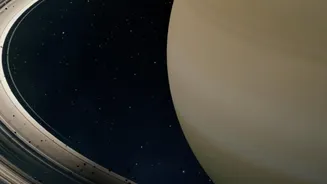
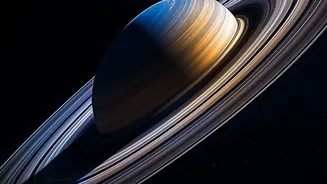
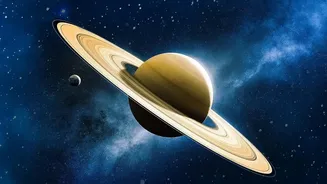
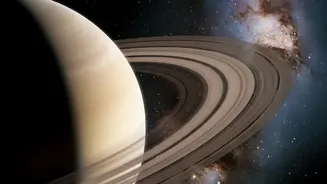
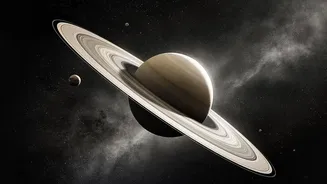
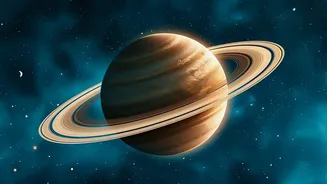
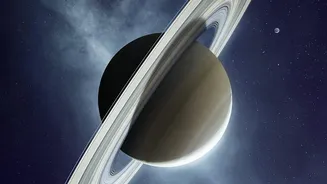
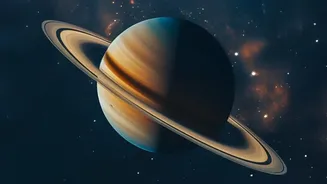
Seeing Saturn's rings for the first time through a telescope is an unforgettable experience. They have a stunning three-dimensional appearance that no other object in the sky can match. In 2026, the rings will be tilted at a narrow angle of about 7 degrees toward Earth, making them appear as a thin, elegant line crossing the planet. With a medium-sized amateur telescope, you might be able to spot the Cassini Division, a prominent dark gap that separates the main A and B rings. The rings cast a subtle shadow on the planet's surface, enhancing its spherical shape and providing a view that photos can't fully capture.
Spotting Saturn's Moons
Saturn is accompanied by a large family of moons, and several of the brightest are visible with amateur telescopes. The easiest to spot is Titan, Saturn's largest moon. A small telescope will show it as a distinct point of light near the planet. With a telescope of 4 inches or more, you may also be able to identify other moons like Rhea, Dione, and Tethys. These appear as tiny, star-like specks orbiting the planet. Using a stargazing app or an online tool can help you identify which moons are visible and where they are located on any given night. Titan will be northeast of Saturn on August 5-6 and southwest on August 13.
Tips for the Best Viewing Experience in India
While August is part of the monsoon season for much of India, clear nights can still offer incredible views. High-altitude regions like Ladakh and Spiti Valley, or rain-shadow areas in the Rann of Kutch, provide the best chances for clear skies. For everyone else, it’s a matter of watching the weather forecast and seizing any opportunity. To get the best view, find a location away from city lights. Allow your eyes about 20-30 minutes to fully adapt to the darkness; this will help you see fainter details. Using a red-light torch instead of a white one will preserve your night vision. Finally, be patient. Atmospheric conditions can change, and moments of steady air will reveal the sharpest details of the planet and its rings.