






A Guest Star Appears
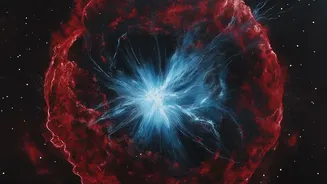
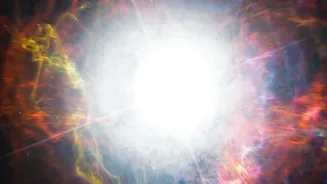
In early October 1604, observers in Italy were the first in Europe to record a startling sight: a 'new star' had appeared in the constellation Ophiuchus, the Serpent Bearer. It grew rapidly in brilliance, soon outshining every star in the night sky and
even the planet Jupiter. For over three weeks, it was visible during the daytime. This celestial visitor, which we now know was a supernova, appeared at a fortuitous time. Astronomers were already watching that patch of sky for a much-anticipated conjunction of Mars and Jupiter, ensuring the event was widely witnessed. Occurring just five years before the invention of the astronomical telescope, all observations were made with the naked eye, relying on instruments to measure its position relative to known stars.
Kepler's Meticulous Account
Though not the first to see it, the event is forever linked with German astronomer Johannes Kepler. Delayed by cloudy weather in Prague, Kepler began his own detailed observations on October 17. Inspired by Tycho Brahe's study of a similar event in 1572, Kepler meticulously tracked the star's position and brightness for over a year until it faded from view. He compiled his findings, along with those of other European astronomers, into his 1606 book, 'De Stella Nova in Pede Serpentarii' ('On the New Star in the Foot of the Serpent Handler'). His crucial finding was that the star showed no measurable parallax, or shift in apparent position, proving it was far beyond the Moon. This directly challenged the prevailing Aristotelian view, supported by the church, that the heavens beyond the Moon were perfect and unchanging.
Records from the East
European accounts were not the only records of this cosmic spectacle. Astronomers in China and Korea, who had centuries-old traditions of monitoring the heavens for such 'guest stars', also documented the 1604 event. Chinese records from the Ming dynasty and Korean observations from the court of King Seonjo provide crucial, independent data points. These Asian records, when combined with European observations, have allowed modern astronomers to reconstruct a more complete and accurate light curve for the supernova, detailing its rise and fall in brightness. This global collaboration across centuries highlights the universal human impulse to look up and record the wonders of the cosmos.
An Astrological and Cultural Phenomenon
In the early 17th century, the lines between astronomy and astrology were blurred. The supernova’s appearance during a major planetary conjunction was seen by many as a powerful omen. Pamphlets circulated across Europe predicting everything from the fall of empires to the Second Coming. As Imperial Mathematician, Kepler himself was required to engage with these astrological interpretations. In 'De Stella Nova', he navigated this world by acknowledging the star's potential significance, linking it to the Star of Bethlehem which also appeared near a great conjunction. However, he ultimately argued that the star's true purpose was to encourage astronomers to observe more carefully and reason more rationally, using precise measurement to understand the cosmos.
The Supernova's Legacy in Modern Science
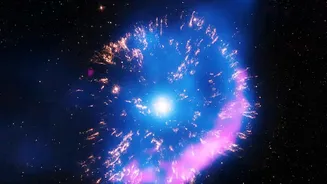
Today, SN 1604 is classified as a Type Ia supernova, the thermonuclear explosion of a white dwarf star in a binary system. The historical records were instrumental in reaching this conclusion. The detailed light curve, constructed from combined global observations, perfectly matches the profile of a Type Ia event. Furthermore, Kepler's precise positional data allowed astronomer Walter Baade to locate the supernova's faint remnant in 1941 using the Mount Wilson Observatory. Now studied by space telescopes like Chandra and Spitzer, the remnant of Kepler's Supernova continues to provide insights into the dynamics of stellar explosions, the creation of heavy elements, and the expansion of the universe.