
A Dress Rehearsal for Other Worlds
Before sending multi-billion dollar missions and human lives into the cosmos, space agencies like NASA and the European Space Agency (ESA) need to be sure their plans, equipment, and people are ready for the challenge. They do this through 'analogue missions'—simulations
conducted in places on Earth that mimic the geological or environmental conditions of the Moon, Mars, or other celestial bodies. These terrestrial analogue sites serve as cost-effective, low-risk training grounds where every aspect of a mission can be put to the test. From the volcanic fields of Iceland to the bone-dry deserts of Chile, these locations act as stand-ins for extraterrestrial landscapes, allowing scientists and engineers to work out the kinks before ever leaving Earth.
From Blueprints to Boots on the Ground
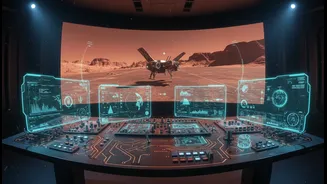
A mission plan that looks perfect on paper can fall apart when faced with the messy reality of a planetary surface. Analogue sites are the critical bridge between theoretical mission design and real-world geological observation. Here, mission designers can test how a rover’s navigation software handles unpredictable, rocky terrain, not just a clean computer model. They can simulate communication delays with a 'Mission Control' team hundreds of miles away to refine how astronauts and ground crews work together. These exercises reveal the practical challenges of exploration: How long does it really take to collect a rock sample in a bulky spacesuit? What tools are most effective? What happens when a key piece of equipment fails? By wrestling with these problems on Earth, mission planners can refine their strategies and technologies, ensuring that astronauts are prepared for the operational realities of working on another world.
Earth's Most Alien Landscapes
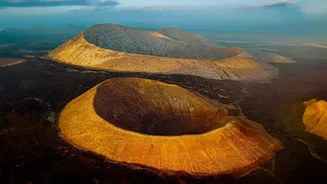
The portfolio of analogue sites is as diverse as the worlds we hope to explore. For lunar missions, planners turn to landscapes forged by fire. The volcanic fields of Iceland and the San Francisco Volcanic Field in Arizona, with their rugged terrain and basaltic rock, have been used since the Apollo era to prepare astronauts for the Moon. These same sites are now used to train the Artemis generation of explorers. To simulate Mars, scientists venture to the Atacama Desert in Chile, one of the driest places on Earth, where the hyper-arid soil closely resembles that of the Red Planet. Other key Mars analogues include the Haughton Crater on Devon Island in Canada, a polar desert whose impact crater landscape is a near-perfect double for Martian terrain, and the geochemically unique Rio Tinto river in Spain.
Training the Eyes of an Explorer
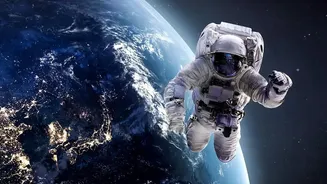
Beyond testing hardware, analogue missions are crucial for training the human explorers themselves. Astronauts are often pilots and engineers by trade, but on the Moon or Mars, they must also become proficient field geologists. Programs like ESA’s PANGAEA (Planetary Analogue Geological and Astrobiological Exercise for Astronauts) take astronauts to various sites across Europe—from impact craters in Germany to volcanic islands in Spain—to teach them how to read the story of a landscape. They learn to identify different rock types, understand geological formations, and make scientifically informed decisions about which samples are most valuable to collect. This hands-on training is irreplaceable. It hones their observational skills, enabling them to effectively communicate what they are seeing to the team of scientists back on Earth and to make crucial discoveries in the limited time they have on the surface.
The Limits of Simulation
Of course, no place on Earth is a perfect replica of another world. Our planet has stronger gravity, a thick, protective atmosphere, and teeming biology, all of which are absent on the Moon or Mars. A spacesuit worn in Arizona is not subjected to the same temperature swings or radiation as one on the lunar surface. A rover in the Atacama Desert doesn't have to contend with the fine, abrasive Martian dust that can clog mechanisms. Scientists and engineers are well aware of these limitations and work to account for them in their tests. Analogue missions are not about creating a perfect copy, but about simulating specific, relevant aspects of a mission in a controlled way to reduce the number of unknowns and build confidence in the people and technology destined for space.