




The Universe’s Megacities
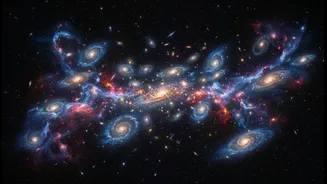
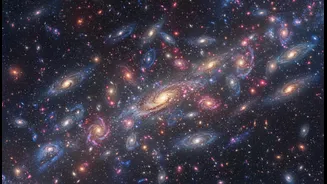
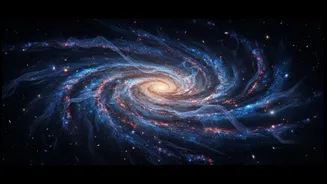
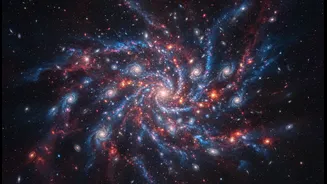
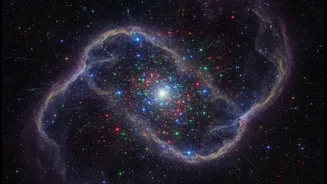
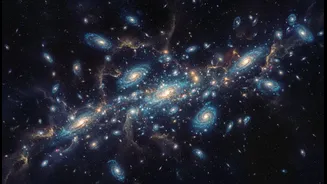
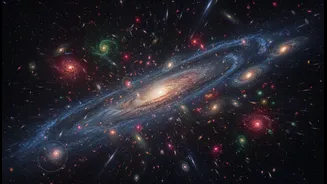
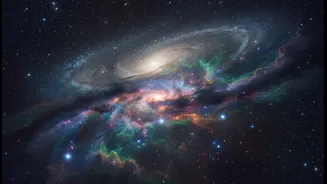
Imagine a city not of people, but of entire galaxies. That’s a galaxy cluster. These are the most massive known objects in the universe held together by gravity, containing hundreds or even thousands of galaxies like our own Milky Way. These clusters
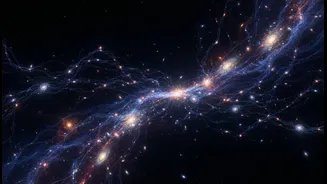
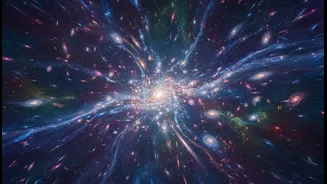
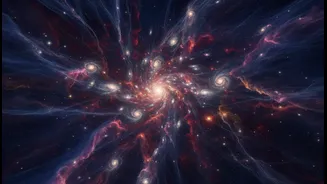
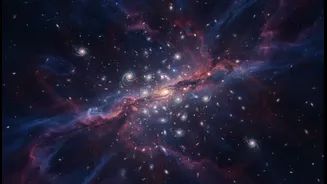
are not just beautiful, chaotic collections; they are the nodes of a much larger, almost invisible structure known as the cosmic web. This web is made of enormous filaments of gas and dark matter stretching across the cosmos, acting as intergalactic highways. For decades, astronomers have theorized that these filaments are crucial, funneling raw materials into the intersections where galaxy clusters form and grow.
Opening a Window to the Past
Seeing this process happen has been incredibly difficult. The gas in these filaments is faint, and the clusters themselves are forming billions of light-years away, meaning we are seeing them as they were billions of years ago. This is where the James Webb Space Telescope (JWST) has been a game-changer. Its powerful infrared instruments can peer through cosmic dust and capture the faint light from the dawn of time, allowing astronomers to see these protoclusters—galaxy clusters in their infancy—for the first time with stunning clarity. Recent observations have confirmed the existence of protoclusters that formed when the universe was less than a billion years old, far earlier and faster than many models predicted.
Catching a Cluster in the Act
Several recent breakthroughs have provided direct evidence of this cosmic feeding process. One team of astronomers using the JWST identified a group of seven galaxies bound together just 650 million years after the Big Bang, making it the youngest protocluster ever confirmed. The galaxies were measured moving at incredible speeds, over 3.2 million kph, within a halo of dark matter, confirming they were part of a single, developing structure. In another discovery, scientists produced the sharpest image ever of a cosmic filament, a glowing strand stretching 3 million light-years and linking two galaxies from nearly 12 billion years ago. This provides a direct snapshot of the cosmic web channeling gas to fuel the birth of new stars and galaxies, just as theories predicted.
Rewriting Cosmic History
These findings are more than just pretty pictures; they are forcing a rethink of how quickly the universe grew up. Some of these newly discovered protoclusters are so massive, so early in cosmic history, that their existence is a statistical puzzle. One protocluster, known as JADES-ID1, which existed when the universe was only a billion years old, is already as massive as 20 Milky Way galaxies. According to some models, the chances of such a massive structure forming so early are as low as one in five million. This suggests that the process of structure formation in the early universe was perhaps more rapid and efficient than previously understood, providing new evidence that the cosmos was in a hurry to build its largest structures.
Why It Matters
Studying these nascent galaxy clusters isn’t just about the distant past. It’s about understanding the fundamental physics that govern our universe. By observing how these cosmic cities are constructed, from the filaments that feed them to the interactions between the galaxies within them, we learn about the life cycle of all galaxies, including our own. It helps scientists refine their models of cosmology, test theories about dark matter, and ultimately piece together the story of how a smooth, uniform early universe evolved into the complex, structured cosmos we see today. Each new discovery is like finding a key puzzle piece, bringing the complete picture of our cosmic origins into sharper focus.