





Looking for a move that strengthens your shoulders, sculpts your core, and improves stability all at once? The dolphin push-up is a powerful, often-overlooked exercise that delivers serious results without requiring any equipment.
What Exactly is a Dolphin Push-Up?
The dolphin push-up is
a dynamic upper-body exercise that blends elements of yoga and traditional strength training. Think of it as a moving forearm plank that challenges your stability and strength in a unique way. Unlike a standard push-up where your hands are on the floor, the dolphin push-up is performed on your forearms. This small change shifts the focus dramatically, placing greater emphasis on the shoulders, upper back, and core. It's derived from the yoga posture Ardha Pincha Mayurasana, or Dolphin Pose, but adds a forward-and-back 'push' motion that builds functional strength and prepares the body for more advanced movements like forearm stands and headstands.
The Core and Shoulder Benefits
The primary benefit of the dolphin push-up is its incredible ability to build strong, stable shoulders. It targets the deltoids, the muscles that give your shoulders their rounded shape, while also engaging the smaller stabilising muscles of the rotator cuff. This makes it an excellent exercise for improving shoulder health and resilience. But the advantages don't stop there. To perform the movement correctly, you must keep your core tight and engaged throughout, making it a fantastic abdominal and oblique workout. It also strengthens the triceps, serratus anterior (the muscles along your ribs), and the upper back. This comprehensive engagement makes it a highly efficient exercise for building a powerful and connected upper body.
Your Step-by-Step Guide to Proper Form
Form is everything with the dolphin push-up. Rushing the movement or using improper technique can strain your shoulders and neck. Follow these steps for a safe and effective execution:
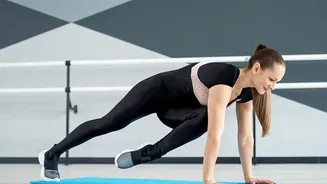
1. Start in a forearm plank position. Your elbows should be directly under your shoulders, and your palms can be flat on the floor or clasped together. Your body should form a straight line from your head to your heels.
2. Engage your core. Pull your belly button in towards your spine to prevent your lower back from sagging.
3. Initiate the movement by lifting your hips up and back, moving into a position that resembles the yoga Dolphin Pose or an inverted 'V'. Your head will naturally move towards your feet.
4. From this peak position, begin to shift your weight forward. Lower your hips and guide your nose or chin forward, past your hands. Your shoulders will travel in front of your elbows.
5. Gently 'kiss' the floor with your nose or come as close as you can without losing form. Your hips should remain lifted and not sink towards the floor.
6. Push back through your forearms to return to the inverted 'V' starting position. That completes one repetition.
Avoiding Common Pitfalls
To get the most out of every rep, be mindful of these common mistakes. First, avoid letting your hips sag during the forward push. This disengages your core and can strain your lower back. Keep your abs tight to maintain a strong, stable torso. Second, don't flare your elbows out to the sides. Keep them shoulder-width apart to properly target the shoulder muscles and protect the joint. Another frequent error is holding your breath. Remember to exhale as you press forward and inhale as you push back to the starting position. Finally, avoid rushing. The dolphin push_up is about control, not speed. A slow, deliberate pace ensures maximum muscle engagement and reduces the risk of injury.
Progressing with Gradual Repetitions
The key to getting stronger with any exercise is progressive overload—gradually increasing the challenge over time. With dolphin pushups, start with a number of repetitions you can complete with perfect form, even if it's only 3 to 5 reps. Focus on quality over quantity. Once you can comfortably complete a set of 8–10 reps with flawless technique, you can start to progress. You can do this by adding another set to your workout. For example, instead of one set of 10, aim for two sets of 8. Another way to advance is to increase the range of motion by trying to bring your chin even further forward. For those finding the full movement too challenging, a great modification is to perform the exercise on your knees, which reduces the amount of body weight you have to move.