





A Steamy Signal from Afar
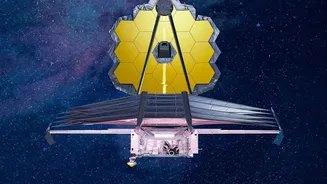
Astronomers have aimed the powerful infrared eye of the James Webb Space Telescope (JWST) at a rocky 'super-Earth' named GJ 486 b, located just 26 light-years away in the constellation Virgo. During the planet's transit—when it passes in front of its
star from our perspective—the telescope detected the unmistakable signature of water vapour. This marks a significant moment in exoplanet science; while water has been found on giant gas planets before, detecting any sign of an atmosphere around a rocky world is a major breakthrough. The planet itself is about 30% larger and nearly three times more massive than Earth, orbiting a cool red dwarf star.
A World of Fire, Not Life
Before we imagine oceans and rain, it is crucial to understand that GJ 486 b is no Earthly paradise. It orbits its star in a blistering-fast 1.5 Earth days, resulting in a scorching surface temperature of around 430 degrees Celsius (800 degrees Fahrenheit). At this temperature, any water would exist only as steam. The planet is also likely tidally locked, meaning one side permanently faces its star in perpetual, searing daylight, while the other is locked in eternal night. So, while the presence of water is exciting, GJ 486 b is far too hot to be considered habitable. The discovery is not about finding another Earth, but about proving that we have the technology to find the ingredients for one.
The Billion-Rupee Question: Planet or Star?
Here's where the story gets complicated. Scientists are cautiously optimistic because there's a catch: the water vapour might not be coming from the planet at all. An equally plausible theory is that the signal originates from the host star itself. GJ 486 b's star is a cool red dwarf, and stars of this type can have 'starspots'—cooler, darker patches similar to sunspots on our Sun. These spots are cool enough for water vapour to concentrate within them, creating a signature that could be mistaken for a planetary atmosphere when the planet passes by. Researchers have confirmed they see a signal that is “almost certainly due to water,” but they cannot yet definitively say if the water belongs to the planet or its star.
Two Possibilities, Both Exciting
If the water is indeed from the planet, it would imply GJ 486 b has an atmosphere despite the harsh radiation from its star—a huge discovery. Given the planet’s intense heat, such an atmosphere would likely need to be constantly replenished, perhaps by steam vented from volcanoes. This would make it the first rocky exoplanet confirmed to have an atmosphere. On the other hand, if the water is from the star, this is also a fascinating finding. It would help astronomers better understand the complex nature of red dwarf stars, which are the most common type of star in our galaxy and a primary target in the search for habitable planets. Either way, the observation is a win for science.
What Comes Next for Webb?
The scientific community is not leaving this as a mystery. To solve the puzzle of the water's origin, more observations are needed. The team plans to use other instruments on the Webb telescope to get a clearer picture. By observing the planet's 'day side', they can measure its temperature more precisely. If the hottest point is where it should be for an airless rock, it might suggest no atmosphere exists. But if the heat is distributed, it would point towards an atmosphere circulating that heat around the planet. These future observations will be critical to distinguishing between a planetary atmosphere and stellar contamination, bringing us one step closer to understanding the conditions on rocky worlds across the cosmos.