

The Universe We Thought We Knew
The standard story of our universe, known as the Lambda-CDM model, has been remarkably successful. It tells us that about 13.8 billion years ago, everything burst forth in the Big Bang. This model is built on pillars of evidence, including the faint afterglow
of the Big Bang, called the cosmic microwave background, and the observed expansion of the universe. It also relies on two mysterious ingredients: dark matter and dark energy. Scientists believe these invisible forces make up about 95% of the cosmos, with dark matter's gravity holding galaxies together and dark energy pushing everything apart at an accelerating rate. For half a century, this has been the accepted narrative.
A Radically Older Cosmos
Now, that long-held consensus is being challenged. Rajendra Gupta, an adjunct professor of physics at the University of Ottawa, has proposed a new model that puts the age of the universe at a staggering 26.7 billion years. This isn't just a minor tweak; it's a fundamental rewrite of our cosmic history. Gupta’s framework, developed with postdoctoral researcher Nikolaos Samaras, is called the CCC+TL model. That mouthful stands for 'Covarying Coupling Constants plus Tired Light', and it suggests that some of our basic assumptions about the physics of the universe might be wrong.
Rethinking Cosmic Rules
The CCC+TL model is built on two key ideas. The first is 'tired light', a concept first proposed in the 1920s which suggests that light loses energy as it travels across vast cosmic distances. This would make distant objects appear redder, a phenomenon that scientists currently attribute solely to the expansion of the universe. Gupta's model combines the tired light effect with expansion. The second part involves 'covarying coupling constants', which suggests that the fundamental forces of nature haven't been constant throughout time. If these physical constants evolve, it changes how we calculate everything from gravity to the speed of light over cosmic history. The most profound implication? This model may not require dark matter or dark energy to work.
Solving a Galactic Puzzle
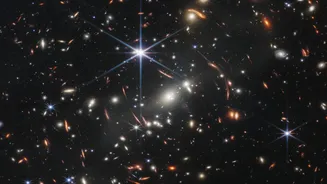
One major motivation for this new model comes from NASA's James Webb Space Telescope (JWST). In recent years, JWST has discovered ancient galaxies that appear surprisingly massive and mature for their supposed age. According to the standard 13.8-billion-year timeline, these 'impossible early galaxies' shouldn't have had enough time to form. They look like they are billions of years old, even though they appear at a time when the universe was supposed to be in its infancy, only a few hundred million years old. By stretching the age of the universe to 26.7 billion years, Gupta's model gives these early galaxies billions of extra years to grow and evolve, potentially solving this baffling cosmic mystery.
A Debate in Progress
Gupta and his team have tested their model against several key observations, including the rotation of 175 different galaxies, and found that it holds up without needing dark matter. However, the CCC+TL model is still very new and sits outside mainstream cosmology. While some of the research has been published in peer-reviewed journals like the Monthly Notices of the Royal Astronomical Society, other parts are still pending review. The wider scientific community has not yet fully embraced the theory, and many believe the standard Lambda-CDM model remains the best explanation for the vast majority of observations. Scientists will need to independently test the model against all the pillars of cosmology, including the cosmic microwave background, before a new consensus can be formed.