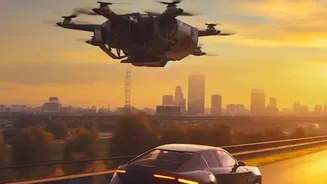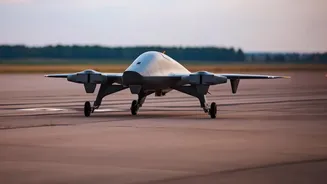







First Off, What Is an eVTOL?
The acronym eVTOL stands for electric Vertical Take-Off and Landing. Think of it as a super-smart hybrid of a drone and a small airplane. Like a helicopter, it can lift off and land straight up and down without needing a runway, making it perfect for crowded
cities. Unlike a helicopter, it’s powered entirely by electricity, using multiple quiet rotors. This makes eVTOLs significantly less noisy, cheaper to operate, and much kinder to the environment. They are specifically designed for what the industry calls Advanced Air Mobility (AAM)—essentially, a new layer of transport that flies over the traffic below.
Who Is Building India’s Air Taxi Network?
The race to launch India's first air taxi service is heating up, with both global giants and homegrown startups in the running. InterGlobe Enterprises, the parent company of IndiGo, has partnered with US-based Archer Aviation to bring an all-electric air taxi service to India. They plan to purchase up to 200 of Archer's 'Midnight' aircraft, a piloted four-passenger vehicle, and aim to start services in Delhi, Mumbai, and Bengaluru. Another major player is Blade India, which already operates helicopter services and has ambitious plans to transition to eVTOLs. The company has agreements to purchase hundreds of aircraft from manufacturers like Eve Air Mobility and Jaunt Air Mobility. Meanwhile, homegrown innovation is thriving. The ePlane Company, a startup incubated at IIT Madras, has developed its own eVTOL called the e200X and recently unveiled its full-scale prototype. Other players like Sarla Aviation and Autosync Aviation are also making significant strides.
How Will It Actually Work?
The process will likely feel similar to booking a cab through an app. You would book your short-haul flight between designated landing pads called vertiports. These could be located on rooftops, at airports, or in other strategic urban locations. For example, the planned service between Delhi's Connaught Place and Gurugram aims to cover a distance that takes up to 90 minutes by car in about seven minutes. Initially, these services will connect key business hubs and provide airport transfers, which are often the most congested routes in major cities. The aircraft are designed for quick, back-to-back flights with minimal charging time, ensuring high efficiency. The government is actively working on the required infrastructure, with the Airports Authority of India (AAI) identifying sites for vertiport construction in major metro areas.
When Can We Actually Take a Flight?
This is the big question. According to India's Civil Aviation Minister, the government is targeting the launch of electric air taxis by 2028. Several companies, including the InterGlobe-Archer partnership, had initially aimed for a 2026 launch but timelines are often adjusted based on regulatory approvals. Before any passenger can board, these aircraft must be certified as safe by the Directorate General of Civil Aviation (DGCA). The DGCA is actively creating a regulatory framework, issuing guidelines for aircraft certification and the operation of vertiports. Companies like Sarla Aviation and The ePlane Company are aiming for test flights around 2027, with commercial operations following after successful trials and certification. So, while the first flights are on the horizon, a widespread, affordable network will likely roll out gradually towards the end of the decade and into the early 2030s.
Is It Just Hype, or Will It Be Affordable?
The vision for air taxis is to be a cost-competitive alternative to ground transport, not just a luxury for the few. Initial estimates for the 7-minute Connaught Place to Gurugram flight hover around ₹2,000 to ₹3,000. While this is more expensive than a regular cab today, it's significantly cheaper than a helicopter and offers unparalleled time savings. As technology matures, manufacturing scales up, and more routes become available, prices are expected to decrease. The use of electricity instead of expensive aviation fuel is a major cost-saver. Furthermore, Indian startups like The ePlane Company and Sarla Aviation are focusing on localising their supply chains and manufacturing, which could dramatically lower production costs and, eventually, ticket prices for passengers. The first services will likely cater to business travellers and emergency medical services, but the long-term goal for many of these companies is to make urban air mobility accessible to a much broader audience.