




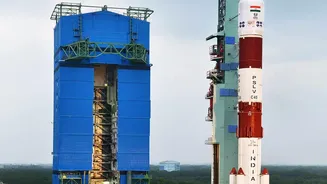

The Great Unlocking of Indian Space
The catalyst for this transformation was a series of government reforms initiated around 2020. The creation of the Indian National Space Promotion and Authorisation Centre (IN-SPACe) established a single-window agency to promote and authorise private
space activities. This policy shift was designed to open up the entire gamut of space activities to Non-Governmental Entities (NGEs), from building launch vehicles and satellites to providing space-based services. Projections show India's space economy, valued at around $8.4 billion in 2023, could surge to $44 billion by 2033. This ambitious growth plan relies heavily on the innovation and investment brought in by the private sector, aiming to increase India's share of the global space market from 2-3% to 10%.
Meet the New Trailblazers
Hundreds of space-tech startups have since mushroomed across the country, attracting significant investment and talent. As of 2026, India has more than 400 active space startups. Companies like Skyroot Aerospace, which launched India's first privately developed rocket, and Agnikul Cosmos, known for its 3D-printed rocket engines, are pioneering launch services for small satellites. In the satellite domain, Pixxel is building a constellation for hyperspectral imaging, and Dhruva Space offers full-stack space engineering solutions. These companies are not just concepts; they are launching missions, securing major funding rounds, and actively hiring.
A New Universe of Job Roles
This private-sector boom is creating a diverse range of jobs that go far beyond traditional aerospace engineering. While demand remains high for specialists in propulsion, avionics, and structural design, new roles are emerging at a rapid pace. Satellite data analysts who can interpret Earth observation data for agriculture, climate monitoring, and urban planning are highly sought after. Aerospace software engineers with skills in C++, Python, and AI are critical for developing flight software and autonomous systems. Other growing fields include space robotics, mission operations, and even space law and policy, as the sector requires a stable regulatory framework. This expansion means that careers in the space industry are now accessible to professionals from a wider range of disciplines, including computer science, data analytics, and law.
ISRO's Evolving Mission: From Doer to Enabler
The rise of private players does not mean the role of ISRO is diminishing. Instead, its focus is shifting. ISRO will continue to lead in advanced research, deep space exploration, and national security missions. Simultaneously, it is taking on the role of a mentor and enabler for the private ecosystem. This is achieved through technology transfer, where technologies developed at ISRO are licensed to private firms to commercialise and scale. Furthermore, startups are gaining access to ISRO's world-class testing facilities and infrastructure, significantly lowering their development costs and timelines. This symbiotic relationship allows ISRO to concentrate on frontier science while the private sector builds a robust commercial space industry around mature technologies.