





A Land of Paradoxical Drought
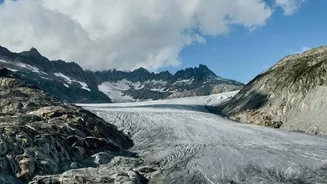
Ladakh, often called the “rooftop of the world,” is a land of extremes. Surrounded by the mighty Himalayas, its landscape is shaped by glaciers and snow. Yet, paradoxically, it is a cold desert, receiving less than 100 mm of rainfall annually in areas
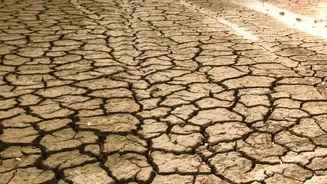
like Leh. For centuries, its communities have relied on a delicate natural cycle: the slow melting of glaciers to feed streams for drinking and irrigating crops like barley and apples during the short growing season. However, climate change is disrupting this ancient rhythm. Glaciers are retreating and winter snowfall is becoming more erratic. This creates a critical mismatch—streamflows peak in the summer when the water is less needed, while spring, the crucial sowing season, is marked by acute scarcity, leaving farmers staring at barren fields.
The Birth of the Ice Stupa
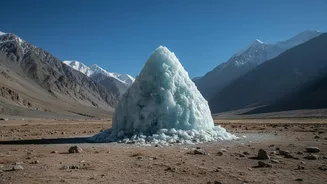
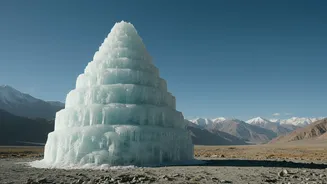
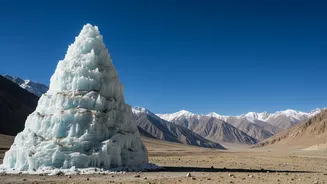
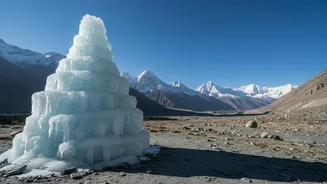
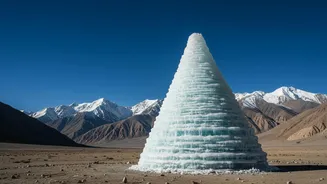
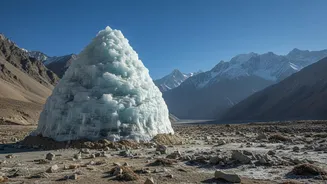
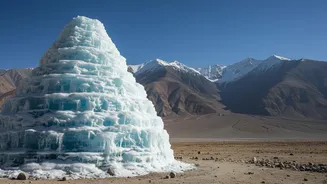
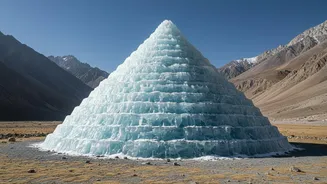
Enter the ice stupa, a revolutionary concept pioneered by Ladakhi engineer and innovator Sonam Wangchuk. The idea was born from a simple observation: even in late spring, ice could be found lingering under a bridge, shielded from the direct sun. Wangchuk realised that the shape of the ice was key to its longevity. While a flat sheet of ice melts quickly due to its large surface area, a vertical cone exposes the minimum possible area to the sun, allowing it to stay frozen for much longer. Inspired by the shape of traditional Buddhist stupas that dot the Ladakhi landscape, he conceived of building artificial glaciers in this conical form, effectively creating frozen water reservoirs right where they are needed most.
Engineering Simplicity with Gravity
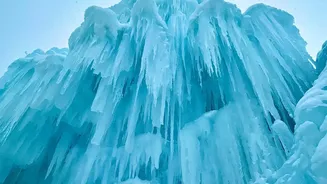
The genius of the ice stupa lies in its elegant simplicity and use of basic physics. The system requires no electricity or complex machinery. During the harsh winter, when water in streams would otherwise flow away unused, a network of underground pipes channels it from a higher altitude. As the pipeline descends, gravity builds up natural pressure. At the stupa site, the pipe rises vertically, and the pressurised water sprays out like a fountain into the sub-zero air. The freezing water falls and gradually accumulates, layer by layer, forming a massive cone of ice that can tower dozens of metres high and store millions of litres of water.
From Frozen Cones to Green Fields
The true magic of the ice stupa happens in the spring. As temperatures rise and farmers prepare their fields, the ice cone begins to melt. Its conical shape ensures that the melting is slow and gradual, providing a steady, reliable source of water from April through June—precisely when it is most needed for irrigation. A single large stupa can hold enough water to irrigate many acres of land, turning previously barren areas green and securing the agricultural cycle for entire villages. The first prototype, built in 2013, successfully stored 150,000 litres and lasted until mid-May. Since then, the project has expanded dramatically, with dozens of stupas built across Ladakh by villagers themselves, fostering a sense of community ownership and climate resilience.