



A Groundbreaking Dress Rehearsal
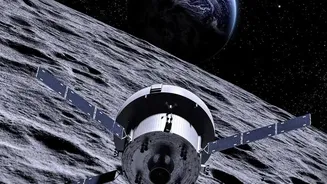
The Artemis II mission was the first crewed flight of NASA's powerful Space Launch System rocket and Orion spacecraft, marking a critical step in the plan to establish a long-term presence on the Moon. For approximately ten days, four astronauts—three
from NASA and one from the Canadian Space Agency—ventured farther from Earth than any human since the Apollo era. Their primary job was not to land, but to test every system on the Orion spacecraft, from life support to navigation, ensuring it was ready for the more complex missions ahead. This lunar flyby served as a crucial 'dress rehearsal', validating the technology and procedures needed to eventually land astronauts, including the first woman, on the lunar surface.
Seeing the Moon with Human Eyes
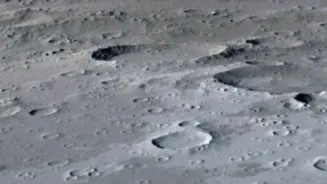
While robotic probes have mapped the Moon extensively, Artemis II reintroduced a vital element to lunar science: the trained human observer. The crew was tasked with a series of ambitious science objectives, using their unique perspective to complement decades of remote sensing data. They captured over 11,000 images and hours of detailed audio observations using a suite of advanced cameras, including handheld Nikon D5s and externally mounted GoPros. This data, totalling over 800 gigabytes, provides an unprecedented look at the lunar surface, especially the far side of the Moon, which humans had not seen directly since 1972. Their mission was to document geological features, note subtle colour variations in the lunar soil, and scout potential future landing sites.
Key Science from the Flyby
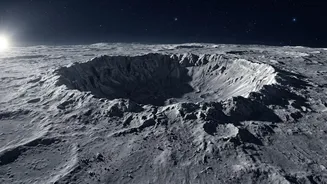
The thousands of images are far more than just pretty pictures. They are a rich dataset that will guide the next phase of exploration. One of the top priorities was to extensively photograph the lunar South Pole region, an area of immense scientific interest because its permanently shadowed craters are believed to hold water ice. High-resolution imagery captured by the crew will help mission planners create detailed maps and identify safe, resource-rich locations for the Artemis III landing. Furthermore, the crew's observations provided new insights into the three-dimensional nature of large impact basins like the Orientale Basin and captured photometric data—how the surface reflects light from different angles—that would take robotic orbiters years to compile.
Flashes in the Dark and Earthrise 2.0
Beyond geological mapping, the mission yielded some astonishing observations. The crew successfully spotted five 'pinprick' flashes of light on the Moon's darkened surface. Scientists confirmed these were likely meteoroid impacts, providing valuable data on the frequency of such events—a critical factor for the safety of future lunar bases. The human element was also on full display as the astronauts provided real-time descriptions of their view, annotating images and noting details that a robotic sensor might miss. And, of course, the mission delivered awe-inspiring new views of 'Earthrise', powerful images of our home planet hanging in the blackness of space, which serve to inspire a new generation much like the original Apollo 8 photograph did.
Paving the Way for Boots on the Moon
Ultimately, every piece of data from Artemis II is a stepping stone. The mission successfully demonstrated the Orion spacecraft's life support systems, navigation capabilities, and the resilience of its heat shield during a high-speed reentry into Earth's atmosphere. The extensive imagery has provided the most detailed reconnaissance for future landing sites since the Apollo program, directly informing the upcoming Artemis III mission, which will finally put boots back on the lunar soil. The science gathered from this flyby has not only deepened our understanding of the Moon’s history and environment but has also proven that humans are ready to once again become active explorers in deep space.