


Start with a Simple Plan
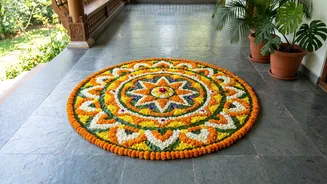
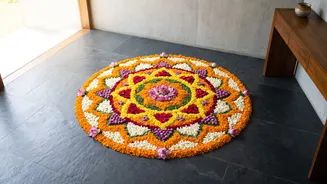
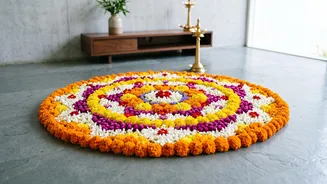
A beautiful pookalam doesn't need to be overwhelmingly complex. In fact, some of the most striking designs are simple and elegant. Before you even think about flowers, decide on your design. Start with a basic geometric shape like a circle, a square,
or a star. Using chalk or rice flour, you can draw a simple outline on your chosen surface. A small, neat design in a compact space like an apartment doorway can have more charm than a large, ambitious one that becomes stressful to complete. The key is symmetry and clean lines, which make even the simplest patterns look polished and intentional.
Forage Your Own Garden and Neighbourhood
The most budget-friendly flowers are the ones you don't have to buy. Before heading to the market, take a look around your own garden or local green spaces. Brightly coloured bougainvillaea, fragrant jasmine, red hibiscus, and various types of leaves can form the foundation of your pookalam. Traditionally, many pookalams were made using locally available wildflowers and plants like Thumba (a small white flower) and Mukkutti. Not only does this save money, but it also connects your celebration to the local environment, adding a layer of personal meaning to your creation.
Master the Art of Filler Flowers
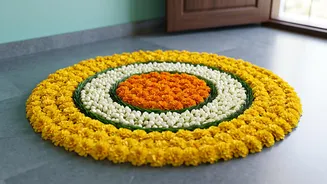
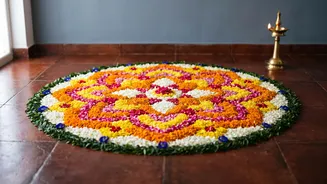
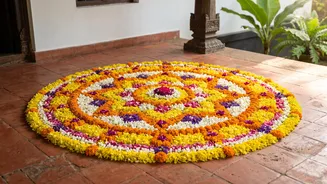
To create a lush, full-looking pookalam, you don't need heaps of expensive petals. The secret is to use affordable, high-volume flowers for the base and borders. Marigolds (jamanthi) are perfect for this; their bright orange and yellow petals are relatively inexpensive, easy to handle, and fill space beautifully. Chrysanthemums are another excellent and affordable choice available in various colours. Use these to create broad rings of colour, and then save the more expensive or delicate flowers for the detailed center or accent patterns.
Think Beyond the Petal
Flowers are the star of the pookalam, but they don't have to be the only element. Incorporating other materials can reduce costs and add interesting textures. Green leaves, for example, can be used to create bold outlines or add a lush, natural border to your design. Some modern interpretations even use coloured rice or sawdust for highlights, which is a great way to introduce colours that are hard to find in flowers, like deep blues or purples. This creative approach allows you to stretch your flower budget while making your design unique.
Embrace Minimalist Colour Palettes
More colours don't always equal a better design. A common mistake is using too many shades, which can make the pookalam look cluttered. Instead, try a limited and high-contrast colour palette. A simple two or three-colour design can be incredibly striking. For instance, a classic combination of yellow marigold petals, white jasmine or tuberose, and red rose petals creates a vibrant and traditional look without needing a huge variety of flowers. Focusing on contrast makes the patterns pop and gives your pookalam a clean, sophisticated feel.
Let the Centrepiece Shine
A simple trick to create a high-impact design is to focus your creative energy on the center. Start your pookalam with a central focal point, such as a single beautiful flower, a traditional brass lamp (diya), or a small, intricate pattern. Then, build simpler, concentric circles of petals around it. This technique draws the eye inward and gives the impression of complexity, even if the outer rings are just simple bands of solid colour. It's a smart way to create a memorable design while conserving your most special flowers and your energy.