





Decoding the Colours of Caution
The India Meteorological Department (IMD) uses a simple, four-stage colour-coded system to alert the public and government agencies about impending weather events. Green means 'All is well,' indicating normal weather with no advisory needed. Yellow asks
you to 'Be Aware,' as weather conditions could worsen and cause minor disruptions. The Orange alert signals you to 'Be Prepared' for extremely bad weather that could disrupt road and rail travel. Finally, a Red alert is the highest warning, meaning 'Take Action.' It signifies that severe weather is expected, posing a significant risk to life and property and likely causing widespread travel and power disruptions.
From Forecast to Action on the Ground
Once the IMD issues a warning for a district, it doesn't just go to the public. It triggers a formal communication chain involving state and national disaster management authorities. These agencies, in turn, disseminate the alerts to transport bodies like the National Highways Authority of India (NHAI) and Indian Railways. This ensures that those responsible for managing our transport lifelines have the advance notice they need to mobilise resources, deploy teams, and take preemptive measures to mitigate risks before the weather hits its peak.
The Railway Response: Protecting Tracks and Passengers
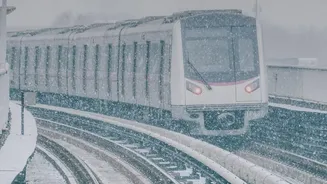
For Indian Railways, an IMD alert, particularly orange or red, sets a series of protocols in motion. The primary threat during monsoons is not just flooding but soil saturation, which can weaken the ground beneath the tracks. In response, railways intensify patrolling, especially in identified vulnerable sections. Stationary watchmen are posted at high-risk bridges and locations. Before the season, joint inspections of tracks and signalling equipment are conducted, and drainage systems in yards are cleared to prevent waterlogging. During a severe alert, train speeds may be restricted, and in extreme cases, services on a particular route might be temporarily suspended to ensure passenger safety. Constant coordination with district authorities about water release from dams is also maintained to protect railway infrastructure.
On the Highways: Preventing Landslides and Gridlock
The NHAI's monsoon preparedness is activated by these same IMD alerts. Vulnerable stretches prone to landslides, flooding, and waterlogging are identified through surveys before the monsoon. When an alert is issued, NHAI deploys Quick Response Teams and machinery like excavators and cranes to these critical points. 24x7 Emergency Response Teams are put on standby to manage any incidents. Pothole repairs are expedited, and drainage systems are cleared to handle heavy water flow. Using AI-based systems and apps like Rajmargyatra, NHAI provides real-time traffic and weather updates to commuters. In hilly regions or areas facing a red alert, this can lead to pre-emptive road closures or traffic diversions to prevent vehicles from getting stranded.
Challenges and the Push for Precision
While the system provides a robust framework, it's not without challenges. Sometimes, the intensity of rainfall can exceed forecasts, leading to criticism that alerts weren't severe enough. There is a growing consensus that while district-level warnings are useful, a more hyper-local approach is needed. Experts and agencies are pushing for integrating on-ground sensors for soil moisture and rock movement with IMD's broader forecasts. This would allow a shift from reacting to broad warnings to predicting specific vulnerabilities, like a particular railway embankment at risk of saturation or a specific highway cliff face showing signs of instability. This evolution towards route-specific forecasting is already underway and promises to make journeys even safer.