






Meet ChaSTE: The Moon's Thermometer
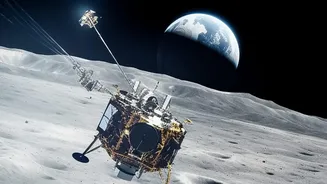
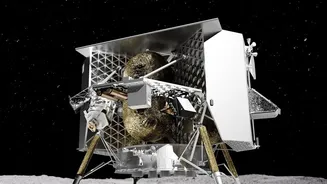
At the heart of this discovery is the Chandra’s Surface Thermophysical Experiment, or ChaSTE. This ingenious instrument, one of several payloads on the Vikram lander, was designed to do something no mission had ever done before: take the temperature of the lunar
topsoil in the south polar region. ChaSTE is essentially a high-tech probe, equipped with a controlled mechanism to penetrate up to 10 centimetres into the lunar regolith—the proper term for the Moon's loose layer of dust and broken rock. The probe is fitted with 10 individual temperature sensors along its length, allowing it to create the first-ever in-situ thermal profile of the lunar south pole. Its mission was to measure how heat behaves on and just below the surface, a critical piece of information for all future lunar endeavours.
A Journey into the Soil
After Vikram's successful landing at Shiv Shakti Point, the ChaSTE probe was deployed. A motor-driven mechanism slowly pushed the probe into the ground, carefully recording data as it went. The resistance the motor encountered offered clues about the soil's compactness. Early on, the probe's motor current was low, indicating it was moving through loose material. But below about 6 centimetres, the current increased significantly, suggesting the soil became much denser and more tightly packed. This was the first hint that the lunar soil wasn't a uniform pile of dust. The primary goal was to measure temperature variations with depth, and the results were startling. At local noon, scientists observed a massive temperature gradient of about 73 Kelvin between the surface and a depth of 10 cm, confirming the topsoil is a fantastic insulator.
Uncovering a Layered Structure
The most recent analysis, published in November 2026, has revealed a complex, hidden structure within just the top 10 cm of soil. Scientists have identified not one, but three distinct layers with different physical and thermal properties. The top layer, extending down to about 3 cm, is an extremely porous and fluffy material, with a porosity of around 80% and a low density. Below this, from 3 to 6 cm, lies a middle layer with higher thermal conductivity. Finally, a third, even denser layer is found between 6 and 10 cm, where the density more than doubles compared to the surface. Researchers noted that this fine-scale layering was neither observed nor expected before.
The 'Hop' That Confirmed the Finding
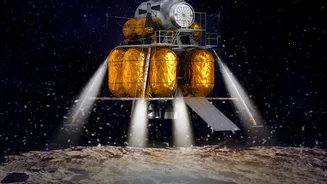
This discovery was further illuminated by Vikram's innovative 'hop' experiment. Near the end of its mission, ISRO engineers used the lander's remaining fuel to fire its engines, lifting it about 40 cm off the surface and landing it roughly 50 cm away. This manoeuvre was a test for future sample-return missions, but it also had a brilliant scientific side-effect. The engine blast blew away the top few centimetres of the loose surface dust at the new landing spot. When ChaSTE took measurements again, it was probing a surface that had its uppermost 'fluff' layer stripped away, allowing for a direct comparison and confirming the layered nature of the regolith.
Why This Hidden Map Matters
Knowing the lunar soil is layered like a cake, rather than being a simple flour bin, has massive implications. For one, the excellent insulating properties of the top layer are crucial for understanding how water ice could remain stable just beneath the surface in sunlit areas, not just in permanently shadowed craters. This broadens the potential sites for future resource prospecting. For engineers planning to build lunar habitats or infrastructure, this data is invaluable. The soil's density and cohesiveness increase significantly with depth, which will affect how foundations are designed and how excavation is planned. It's the difference between building on loose sand versus firm clay, and ChaSTE has provided the first-ever direct measurements to guide those future plans.