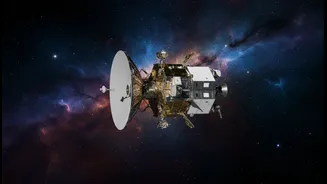









A Pioneer's Long, Quiet Journey
Launched in 2006, New Horizons made history in 2015 with its breathtaking flyby of Pluto, transforming our understanding of the dwarf planet from a distant, fuzzy point of light into a complex world of nitrogen glaciers and icy mountains. Four years later,
it broke its own record for the most distant planetary encounter, studying a primordial Kuiper Belt Object (KBO) named Arrokoth. Since then, the spacecraft has been cruising even deeper into the Kuiper Belt, a vast doughnut-shaped region of icy bodies left over from the formation of the solar system. To conserve power and protect its systems during the long cruise, mission operators routinely place New Horizons into hibernation.
The Art of the Deep Sleep
Spacecraft hibernation is a critical strategy for extending the life of long-haul missions. Much like a bear slowing its metabolism for winter, most of New Horizons' systems are powered down. The spacecraft enters a stable, spinning mode, conserving precious power from its radioisotope thermoelectric generator—a kind of nuclear battery whose output slowly diminishes over decades. But it isn't a total shutdown. A few key science instruments remain active, continuing to gather data on the solar wind, plasma, and dust in its unique corner of the solar system. The craft's computer also sends a weekly status beacon back to Earth, a simple 'I'm okay' signal across the void. According to Mission Operations Manager Alice Bowman, every one of these reports during the latest hibernation was 'green,' indicating all was well.
Waking a Distant Explorer
On June 23, 2026, following commands uploaded a year prior, New Horizons executed its wakeup sequence automatically. Confirmation of this event, however, took nearly nine hours to reach the Johns Hopkins Applied Physics Laboratory in Maryland. Travelling at the speed of light, the radio signal had to cross approximately 9.5 billion kilometres (5.9 billion miles) of space. Now awake, the mission team's first priority is to perform a thorough health check, downlinking engineering data to ensure all systems are functioning correctly after the long nap. Only then will they begin the slow process of retrieving the science data collected while it was asleep.
An Observatory at the Solar System's Edge
While the flybys of Pluto and Arrokoth were its primary objectives, New Horizons' journey is far from over. It has now transitioned into a new role: a unique deep-space observatory. It provides a vantage point no other active mission can match, studying the heliosphere—the vast bubble of charged particles blown out by our sun. This allows scientists to compare its findings with data from the Voyager probes, which are even further out, to build a more complete picture of our solar system's boundary with interstellar space. The spacecraft continues to observe dozens of other KBOs from a distance, measuring the dust environment and searching for clues about how planets form. There is still hope that another suitable flyby target might be found for the late 2020s or 2030s, but for now, its focus is on this remote survey work.