



A Faint Glimmer Reveals a New Moon
In early 2024, astronomers announced the discovery of Uranus's 28th moon, the first to be found in over two decades. Provisionally named S/2023 U1, this tiny satellite is only about eight kilometers in diameter, making it likely the smallest of the planet's
known moons. It was first spotted in November 2023 by astronomer Scott S. Sheppard using the powerful Magellan telescopes in Chile. Confirming its existence required meticulous image processing techniques to pick out its faint signal from the background noise of space. The moon follows a long, 680-day orbit far from the planet. Its discovery is a testament to the power of modern telescopes and processing methods to find incredibly faint and distant objects that previous surveys missed.
Why Uranus Is Such an Enigma
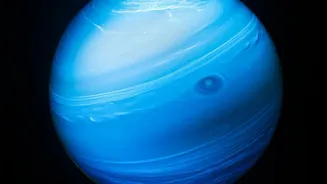
Compared to its gas giant cousins, Jupiter and Saturn, Uranus is largely unexplored territory. To date, only one spacecraft, Voyager 2, has ever visited, and that was for a brief flyby in 1986. The planet is most famous for its extreme axial tilt of nearly 98 degrees, which means it essentially orbits the sun on its side, resulting in bizarre seasons that last for 21 years. Scientists theorize this tilt was caused by a cataclysmic collision with an Earth-sized object billions of years ago. Its faint, narrow rings and system of moons are also fundamentally different from those of Saturn. These oddities make Uranus a prime target for scientists trying to piece together the chaotic early history of our solar system.
Cosmic Crumbs as Historical Clues
So how can a tiny moon like S/2023 U1 reveal this history? Moons come in two main types: regular ones that form from a disk of gas and dust around a planet, and irregular ones that are captured later. The distant and eccentric orbit of S/2023 U1 suggests it is an irregular moon, captured by Uranus's gravity long ago. Such moons are essentially pristine relics from the early solar system. By studying its orbit and composition, scientists can model the gravitational environment around Uranus billions of years in the past. These groupings of captured moons act as data points, allowing researchers to rewind the clock and understand how the giant planets migrated and settled into their current positions, scattering smaller objects as they went.
Unlocking the Secrets of Ice Giants
The discovery adds another piece to the puzzle of the Uranian system, which also includes a tightly packed collection of inner moons and a handful of larger, classical satellites. Some of these inner moons act as 'shepherds,' using their gravity to keep the planet's thin rings from dissipating. Understanding the entire system—from the innermost ring particles to the most distant captured moons—provides a complete picture of its formation and evolution. The finding of S/2023 U1 comes as excitement builds for a dedicated mission to the ice giant. A Uranus Orbiter and Probe has been named the highest-priority flagship mission by planetary scientists for the next decade. Such a mission would spend years studying the planet, its atmosphere, rings, and moons in unprecedented detail, turning these faint glimmers of understanding into a clear picture.