








The Challenge of Urban Heat
Anyone who has walked barefoot on a dark pavement in the summer knows it absorbs a huge amount of heat. Now, imagine that effect scaled across an entire city. This is the urban heat island effect, where cities are significantly warmer than surrounding
rural areas because concrete, asphalt, and other building materials soak up and re-radiate the sun's heat. In India, where cities are dense and summer temperatures can be extreme, this creates major challenges. It increases energy demand for air conditioning, worsens air pollution, and poses health risks to residents. Traditionally, solutions have focused on the visible world: planting more trees, creating green roofs, and using reflective paints. While important, a new frontier of climate research is looking downwards, into the very ground our cities are built on.
An Overlooked Natural System
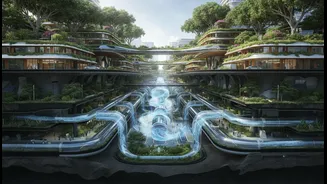
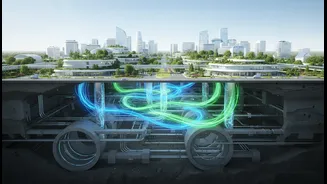
Beneath the bustling streets lies a complex world that scientists are only just beginning to fully understand in an urban context. This subterranean environment, consisting of soil, rock, aquifers, and man-made structures like tunnels and basements, is not static. It has its own thermal properties, with the earth maintaining a relatively stable temperature a few metres below the surface, regardless of the season. Furthermore, air moves through this underground network, a process influenced by soil composition, moisture, and even the rush of water through sewer systems or subway tunnels. This natural movement and thermal stability offer a massive, untapped resource for regulating urban temperatures.
Harnessing the Earth for Cooling
The core idea is surprisingly simple and inspired by ancient techniques. For centuries, civilizations in hot climates have used underground spaces for cooling. Modern research is formalising this with concepts like Earth Air Tunnel Heat Exchangers (EAHE). These systems involve burying long pipes deep enough to take advantage of the stable ground temperature. In the summer, hot surface air is drawn through these pipes. As it travels, the air transfers its heat to the cooler surrounding earth and enters buildings at a significantly lower temperature, dramatically reducing the need for conventional air conditioning. Studies have shown this can lower air temperatures by several degrees with minimal energy cost, offering a sustainable cooling solution.
A New Look at Geothermal
This research dovetails with the growing interest in geothermal cooling, which uses the ground as a heat sink. Instead of just cooling air, geothermal systems can circulate water through underground pipes to provide chilled water for entire buildings or even districts. The Indian School of Business campus in Mohali already uses a geothermal system across 70 acres, saving 30% in electricity and millions of litres of water annually. Indira Paryavaran Bhawan in New Delhi, which houses the Ministry of Environment, also uses a geothermal system. By understanding subsurface airflow, engineers can better design and place these systems for maximum efficiency, turning the ground beneath our cities into a giant, shared cooling utility.
More Than Just Temperature
The benefits of understanding underground airflow may extend beyond just cooling. The complex matrix of soil and rock can also act as a natural filter. As urban air is drawn underground, pollutants and particulate matter could potentially be trapped in the soil, delivering cleaner air back to the surface. Furthermore, the shape and layout of buildings themselves create micro-circulations that trap pollutants at street level. By integrating a better understanding of both above-ground and below-ground airflow, urban planners could design cities that not only stay cooler but also actively manage and disperse air pollution more effectively, improving public health. The turbulence generated by buildings interacts with these underground systems in ways we are just starting to model.
Building the Cities of Tomorrow
Translating this research into reality requires a shift in thinking. Urban planners and architects need to see the ground as an active part of a building's climate control system, not just a foundation to build upon. This means integrating knowledge about local geology and hydrology into master plans. Future infrastructure projects, like new metro lines or utility tunnels, could be designed with a dual purpose: transportation and as conduits for thermal exchange. Pilot projects are essential to test these concepts in the unique context of Indian cities. With supportive policies, such as a national mission for geothermal cooling, and collaboration between researchers, developers, and government, these underground clues could pave the way for more resilient, livable, and sustainable urban environments across the country.