
The Legend of the Six Lost Temples
The magnificent Shore Temple at Mahabalipuram, a UNESCO World Heritage Site, stands as a sentinel against the Bay of Bengal. But for centuries, local lore and ancient accounts have insisted it is not alone. The legend speaks of the 'Seven Pagodas', a complex
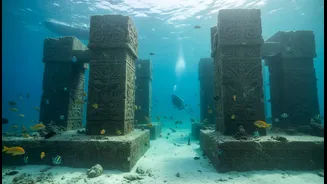
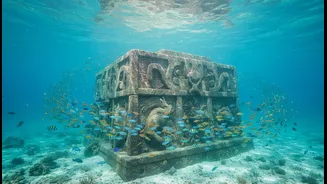
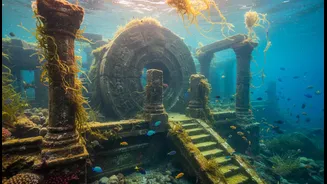
of temples so beautiful that the gods grew envious and submerged six of them in a great flood, leaving only one on the shore as a reminder of what was lost. This captivating story, passed down by fishermen and recorded by European travellers as far back as the 18th century, has long been dismissed by some as mere folklore. Yet, it has stubbornly refused to fade, fueling a persistent quest to find the truth hidden beneath the waves.
A New Scientific Quest Begins
After a gap of nearly two decades, the quest has been reignited. The Archaeological Survey of India’s (ASI) Underwater Archaeology Wing (UAW) has recently resumed its exploration of the submerged remains off the Mahabalipuram coast. This new phase of fieldwork builds upon earlier investigations conducted in the early 2000s, which yielded tantalising evidence of man-made structures below the surface. The 2004 Indian Ocean tsunami briefly and dramatically pulled the water back by 500 meters, revealing long rows of large rocks and what appeared to be walls before the sea rushed back in. This fleeting glimpse, witnessed by locals and tourists, transformed the legend into a tangible scientific possibility and spurred a new wave of interest.
Technology Meets Ancient Mystery
This is not just a repeat of past efforts. The new ASI team is armed with advanced technology, most notably a Remotely Operated Vehicle (ROV). This underwater drone can venture into deeper, more challenging environments to capture high-resolution images and videos of the seabed without disturbing the fragile potential remains. It represents a major leap in precision and safety from the earlier expeditions that relied primarily on sonar and human divers. In past explorations, joint teams from India's National Institute of Oceanography (NIO) and other international bodies used sonar to map the seafloor, identifying anomalies that were later inspected by divers. These efforts found evidence of walls, platforms, and scattered dressed stone blocks at depths of up to 8 meters.
What the Evidence Suggests
Past discoveries have been significant. Investigations in 2004-05 confirmed the presence of submerged structures, including walls and carved architectural pieces from what appeared to be ancient temples of the Pallava dynasty (7th-8th century CE). Some discoveries included a 10-meter long wall and a flight of stairs, found nearly 800 meters from the current shoreline. Divers reported that many structures were obscured by thick marine growth, making identification difficult but confirming they were man-made. Some findings even suggest a history far older than the Pallavas, with discoveries of brick structures characteristic of the Sangam period, potentially dating back 2000 years. These clues point not just to individual temples, but possibly to an entire submerged portion of the ancient port city.
Solving a Millennial Riddle
The challenge for the team is immense. Distinguishing between man-made structures and natural rock formations, dating the ruins, and reconstructing a timeline from scattered, submerged evidence is a complex archaeological puzzle. The goal, as the ASI stated, is to “solve the riddle of the ancient past.” Whether the discoveries ultimately prove the legend of the Seven Pagodas, reveal a different history of coastal erosion and multiple tsunamis, or uncover something else entirely, the project holds immense value. It is a powerful fusion of India’s rich cultural heritage and its growing scientific prowess. This mission is about more than just finding lost temples; it is about reclaiming a submerged chapter of history.