



A Fleeting Cosmic Wonder
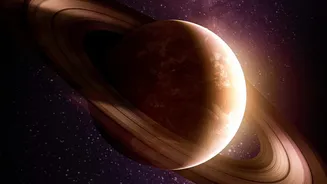
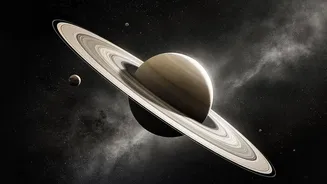
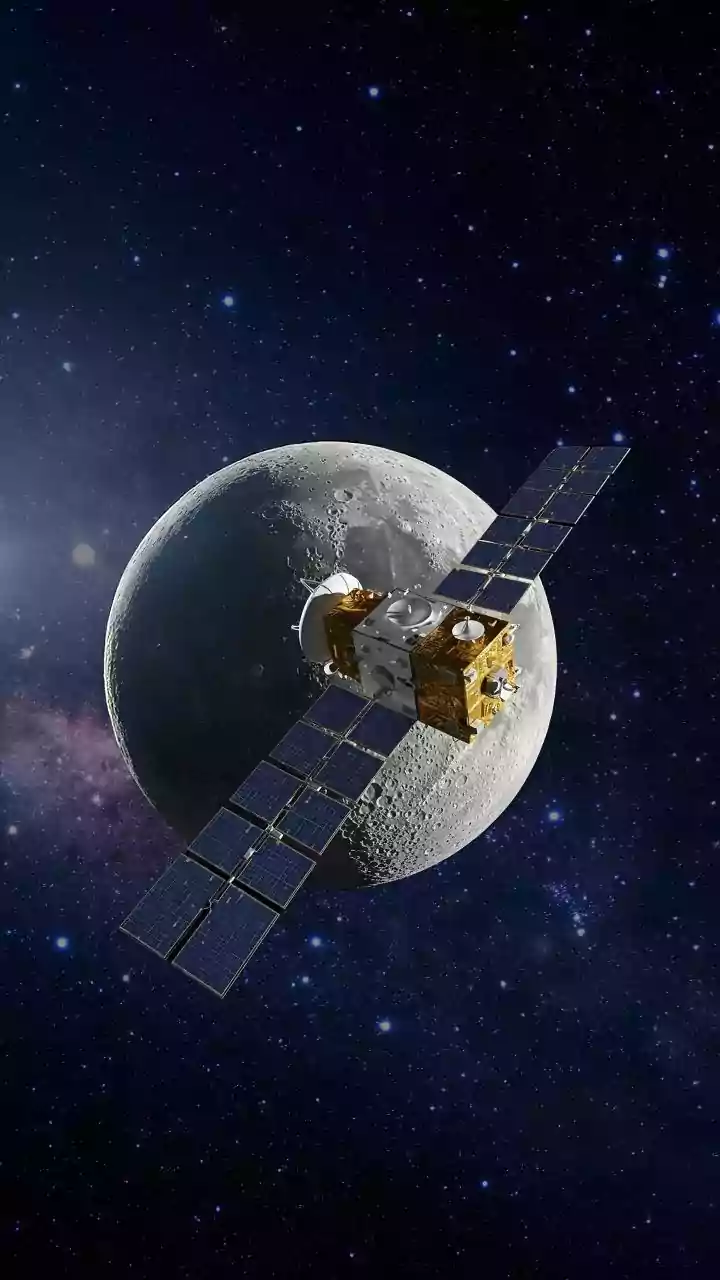
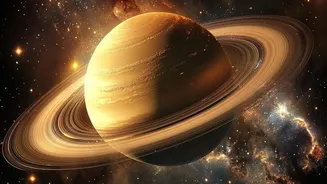
For centuries, astronomers believed Saturn's rings were as old as the planet itself, a primordial feature formed 4.5 billion years ago. However, data from NASA's Cassini mission, which studied the planet for 13 years, has painted a dramatically different
picture. The rings are astonishingly young, likely forming just 100 to 400 million years ago. This means they may have appeared when dinosaurs still roamed the Earth. This relative youth was determined by measuring the 'pollution' of the rings. Comprised of 99% pure water ice, they are constantly bombarded by micrometeoroids and dust. By measuring the rate of this cosmic dust accumulation, scientists concluded the rings haven't been around long enough to get 'dirty'.
The Shepherds of the Rings
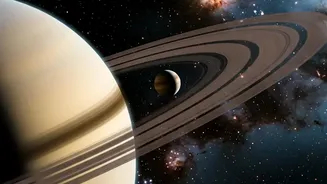
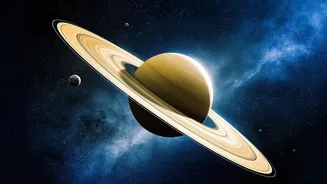
The intricate structure of the rings, with their sharp edges and mysterious gaps, isn't an accident. It's actively managed by some of Saturn's many moons. Small 'shepherd' moons orbit within or just outside the rings, and their gravitational pull is what keeps the ring particles in line. Much like a shepherd herding a flock, these moons prevent the particles from drifting away, effectively sculpting the rings' edges. For example, the F ring is famously confined by two moons, Prometheus and Pandora. The moons' gravity can also create mesmerising waves and propeller-like features within the ring material, adding to the system's dynamic nature.
A System of Constant Change
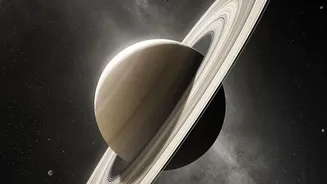
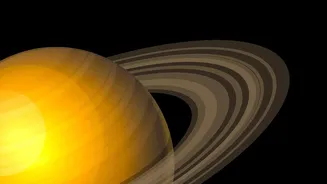
The rings are not a solid structure but a colossal swarm of individual particles, ranging from the size of dust grains to mountains. These countless chunks of ice and rock are in a state of perpetual motion, colliding, clumping together, and breaking apart. The Cassini spacecraft observed temporary, elongated clumps of ice boulders that constantly form and disperse. It also revealed that the rings have their own atmosphere, composed of molecular oxygen, which is created when sunlight interacts with the water ice. This constant churn makes the rings less like a static photograph and more like a bustling, ever-changing metropolis of ice.
The Beginning of the End: Ring Rain
One of the most startling discoveries is that the rings are actively disappearing. This isn't a slow erosion, but a veritable downpour. Scientists have named this phenomenon 'ring rain'. Particles from the rings, charged by solar radiation or jolted by micrometeoroid impacts, are pulled along the planet's magnetic field lines and fall into its upper atmosphere. Cassini's final orbits revealed this is happening at a staggering rate, with an estimated 10,000 kilograms of ring material raining down on Saturn every second. This cosmic rain not only contains water but also complex organic molecules like methane and propane, influencing the chemistry and temperature of Saturn's atmosphere.