




The World’s Largest Telescope
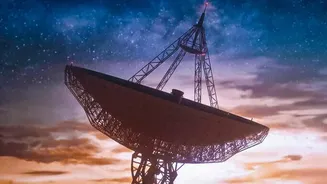
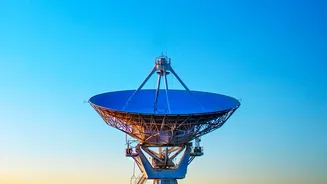
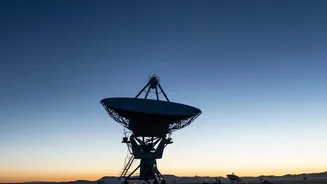
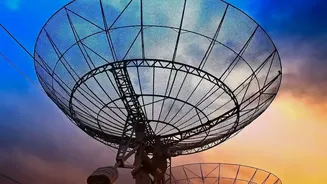
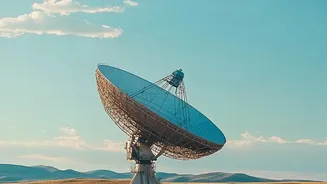
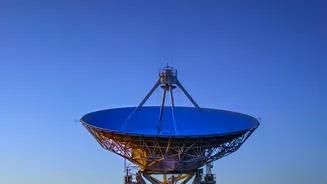
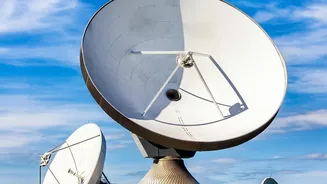
The Square Kilometre Array (SKA) isn't a single telescope but a global project to build the largest scientific instrument on Earth. Managed by the international SKA Observatory (SKAO), it consists of two separate, continent-spanning arrays. In South Africa's
Karoo region, nearly 200 dish antennas make up the SKA-Mid telescope, designed to observe mid-frequency radio waves. Meanwhile, in the remote Western Australian outback, over 131,000 Christmas-tree-like antennas form the SKA-Low telescope, which listens for low-frequency signals. These sites were chosen for their radio quietness, far from the interference of modern life. With construction having started in 2022, the project brings together 16 nations, including Australia, South Africa, the United Kingdom, China, and India, in a monumental quest for cosmic knowledge.
Peering into the Cosmic Dawn
The headline mission for the SKA is to witness a period known as the Cosmic Dawn and the subsequent Epoch of Reionisation. This was the era, in the first billion years after the Big Bang, when the universe emerged from a 'dark age' of neutral hydrogen gas and the very first stars and galaxies began to form. Their light started ionising the surrounding gas, a process the SKA aims to map in three dimensions. To do this, SKA-Low will hunt for the faint radio signal emitted by neutral hydrogen at a specific wavelength (21cm). Due to the expansion of the universe, this ancient signal has been stretched to much longer wavelengths, which is precisely what SKA-Low is designed to detect. By capturing this faint glow, astronomers can create maps of the early universe, watching as the first cosmic structures carve out bubbles in the primordial gas, effectively observing the universe switching on.
Unprecedented Sensitivity and Scale
So, why is the SKA so uniquely powerful for this task? The answer lies in its sheer scale and cutting-edge technology. The core principle is interferometry, where signals from thousands of antennas spread over vast distances are combined to simulate a single, gigantic virtual telescope. This gives the SKA two critical advantages: sensitivity and resolution. The combined collecting area of the arrays will make the SKA 50 times more sensitive than any previous radio telescope, allowing it to detect incredibly faint signals from the edge of the observable universe. The long distances between antennas—up to 150 km—provide astonishingly sharp resolution, enabling it to produce images with detail that can exceed that of the Hubble Space Telescope. This combination of a huge field of view and high sensitivity also means the SKA can survey the sky thousands of times faster than existing telescopes.
A Data Revolution in Astronomy
This incredible power comes with an equally massive challenge: data. The SKA telescopes will generate a flood of information far beyond anything astronomy has handled before, with raw data approaching a terabyte per second. This data will be funnelled from the antennas via fibre optic cables to on-site supercomputers for initial processing. These powerful machines, among the fastest in the world, will correlate the signals before they are sent to a global network of science centres for astronomers to analyse. This requires entirely new software and data-handling techniques, pushing the boundaries of computing and making the SKA as much a big data project as it is an astronomy project. The development of this software is itself a global collaboration, relying heavily on open-source technologies.
Beyond the First Stars
While discovering the first signals from space is a primary goal, the SKA's capabilities will transform many other areas of astrophysics. Scientists will use its sensitivity to test Einstein's theory of general relativity in extreme environments by timing the pulses from spinning neutron stars called pulsars. It will investigate the nature of cosmic magnetism, map the structure of our own Milky Way, and search for the complex molecules that are the building blocks of life around distant stars. The SKA will also play a key role in cosmology by charting the distribution of galaxies over cosmic time, helping to unravel the mysteries of dark matter and dark energy. Its versatility ensures that global astronomy teams will depend on it for breakthrough discoveries for decades to come.