



What Exactly Is Dragonfly?
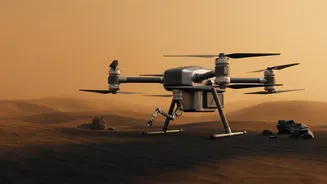
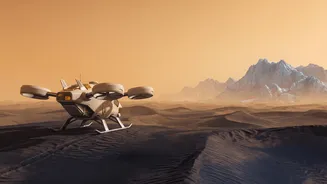
Imagine a science laboratory the size of a car, equipped with eight rotors, capable of flying through the skies of another world. That, in essence, is Dragonfly. It's a dual-quadcopter lander, designed to take advantage of Titan's unique environment.
Unlike rovers that crawl across a surface, Dragonfly will be able to fly from one location to another, covering dozens of sites that would otherwise be unreachable. Scheduled to launch in July 2028 and arrive on Titan in 2034, this mission represents a revolutionary approach to planetary exploration. It won’t just be the first vehicle to perform powered, controlled flight on another moon; it will be a mobile, nuclear-powered science station on a mission to hunt for the building blocks of life.
Why Is NASA So Interested in Titan?
Titan is an explorer's utopia. It's the only moon in our solar system with a dense atmosphere and the only world besides Earth with stable liquid on its surface in the form of rivers, lakes, and seas. However, its weather system is based on methane, not water. Titan's atmosphere is mostly nitrogen, similar to Earth's, but it's also rich in complex organic molecules. These carbon-based compounds rain down from the atmosphere, blanketing the surface. Scientists believe Titan today may resemble a frozen version of early Earth, before life began. It possesses a water-ice crust, a suspected subsurface ocean of liquid water, and an abundance of the very ingredients that, on our planet, eventually led to life. This makes it a prime target for astrobiology.
The Search for Prebiotic Chemistry
Dragonfly's primary objective is to investigate 'prebiotic chemistry'. This is the study of how complex organic molecules, the building blocks of life, form and self-organize. On Earth, the geological and biological activity over billions of years has erased the evidence of these early chemical steps. Titan, however, may be a perfectly preserved laboratory. The mission will specifically target areas where liquid water, from an impact melt or a cryovolcanic flow, may have mixed with the organic materials on the surface. These transient pools could have created a 'primordial soup', kickstarting chemical reactions that lead to biologically relevant molecules like amino acids. Dragonfly is equipped with a suite of instruments, including a mass spectrometer and a drill, to sample and analyze the surface composition, looking for these chemical biosignatures.
A Flying, Nuclear-Powered Laboratory
Exploring Titan is not easy. It is incredibly cold, with surface temperatures around -179°C, and receives very little sunlight, making solar power impractical. To overcome this, Dragonfly will be powered by a Multi-Mission Radioisotope Thermoelectric Generator (MMRTG), the same type of nuclear power source used by the Curiosity and Perseverance rovers on Mars. This provides a consistent source of heat and electricity for the mission's planned 3.3-year science phase. Flying on Titan is also uniquely feasible. Its atmosphere is four times denser than Earth's, while its gravity is only about one-seventh as strong. This combination means that a rotorcraft can operate much more efficiently than it could on Earth or Mars, allowing Dragonfly to hop several kilometers in a single flight to explore diverse geological settings.
What Will the Mission Look Like?
Upon its arrival in 2034, Dragonfly will land in a dune field named Ahmakiq Undae, near the Selk impact crater. This site was chosen because scientific analysis suggests the impact that created the crater melted the local ice, forming a large, temporary pool where water and organic materials could have mixed for thousands of years. From this initial landing zone, Dragonfly will begin its exploration, flying to new sites, collecting samples with its drill, and analyzing them in its onboard laboratory. The goal is to build a detailed picture of Titan's habitability, understand its active methane cycle, and determine just how far the journey toward life has progressed on this fascinating moon. Each flight and every sample will bring us closer to understanding not only Titan, but also the fundamental question of how life can begin.