





The Challenge of Deep Space
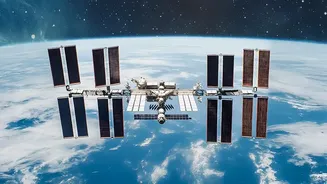
A round trip to Mars, including time on the surface, is a marathon, not a sprint. The immense distance means a mission could take anywhere from two to three years to complete. Unlike the International Space Station (ISS), which orbits just a few hundred
kilometres above Earth and can be resupplied, a Mars-bound crew would be completely on its own. The sheer mass of oxygen and water needed for such a trip makes launching with a full supply impossible. This supply problem has been a primary barrier to deep space exploration, forcing engineers to rethink the very concept of life support from a disposable model to a sustainable, closed-loop one.
Learning from the International Space Station
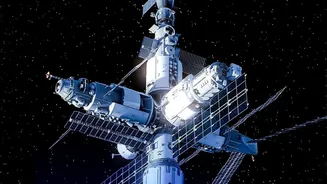
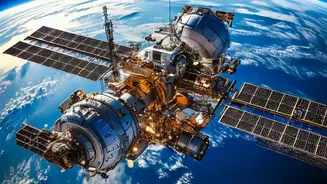
The ISS serves as a crucial testbed for life support technologies. Its Environmental Control and Life Support System (ECLSS) is a marvel of engineering, capable of reclaiming wastewater and generating oxygen. The system scrubs carbon dioxide from the air and uses electrolysis to split water into hydrogen and breathable oxygen. However, the ISS's system is only partially closed; it still requires regular water resupply from Earth to make up for losses and inefficiencies in the process. For example, the current Sabatier system on the ISS recovers only about half of the oxygen from the carbon dioxide it processes. This level of efficiency is a fantastic achievement for low-Earth orbit but is not sustainable for a Mars mission where there are no resupply options.
The Carbon Dioxide Revolution
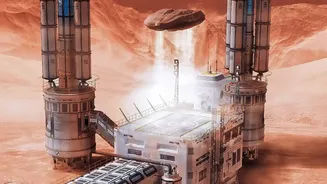
The key innovation enabling Mars missions is the ability to “close the loop” on carbon dioxide. Astronauts exhale CO2, and historically, this waste product was simply scrubbed from the air and vented. New technologies aim to capture nearly 100% of this CO2 and break it down to regenerate oxygen. A pioneering example of this concept is the Mars Oxygen In-Situ Resource Utilization Experiment, or MOXIE. This lunchbox-sized device, part of the Perseverance rover, has successfully and repeatedly produced oxygen by pulling carbon dioxide directly from the thin Martian atmosphere. Between 2021 and 2023, MOXIE proved that the principle works on another planet, hitting and even doubling its oxygen production targets in various conditions. This demonstrates the feasibility of sending a much larger, scaled-up system to Mars ahead of astronauts to produce breathable air and even rocket propellant for the return journey.
New Systems, Greater Efficiency
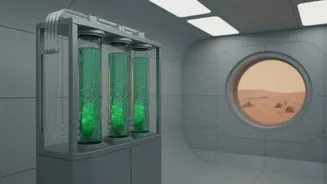
Building on these principles, agencies are developing more robust and efficient systems. ESA's Advanced Closed Loop System (ACLS) installed on the ISS is designed to recycle 50% of the CO2 back into oxygen, saving hundreds of litres of water per year. NASA is pursuing its SpaceCraft Oxygen Recovery (SCOR) project, which aims to develop technologies that recover over 75% of the oxygen from CO2, a significant jump from the current Sabatier system. Other promising research includes Dual Function Materials (DFMs) that can both capture and convert CO2 in a single, more efficient step, potentially halving the mass and power requirements of air revitalization systems. Another UK-based project, CHRSy, uses a catalyst-free approach to convert CO2 into water, making it easier to maintain on long missions. These innovations are all driving toward the same goal: a life support system that is not just a consumer of resources, but a regenerator of them.
Achieving True Self-Sufficiency
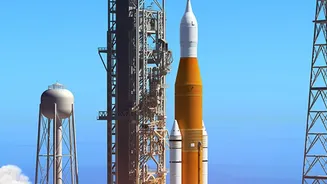
Ultimately, these air recycling breakthroughs are about achieving Earth-independence. A truly closed-loop system, which efficiently recycles air and water, is the foundation for any long-duration human presence beyond our planet. By creating a miniature, artificial ecosystem within the spacecraft, these technologies reduce the mission's reliance on massive upfront supplies, making the entire venture more feasible and affordable. It transforms the spacecraft from a temporary shelter into a sustainable habitat. While rocket propulsion and radiation shielding often dominate headlines, it is the quiet revolution in life support and air revitalization that is steadily turning the dream of sending humans to Mars into an achievable engineering reality.