







The Monsoon's Annual Assault on Our Roads
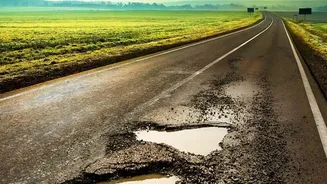
Every year, it’s the same story. Heavy rains lash down, and soon after, our city streets and highways begin to resemble an obstacle course. Potholes emerge, seemingly overnight, turning daily commutes into a bone-jarring ordeal that damages vehicles and causes
accidents. In 2022 alone, potholes were responsible for nearly 4,500 accidents and over 1,800 fatalities in India. The cycle of damage and repair is not only dangerous but also incredibly costly, with the government allocating thousands of crores for road maintenance annually. The core problem is water. When rain seeps into small, existing cracks in the asphalt, it weakens the underlying layers of the road, and the pressure from passing vehicles does the rest, creating the craters we all know too well.
Enter Self-Healing Roads
Imagine a road that can fix itself. It sounds like science fiction, but it’s a reality being developed by scientists around the world, including in India. The concept is known as self-healing asphalt or bio-asphalt. Instead of being a passive material that simply degrades over time, this innovative pavement contains active agents that can repair minor cracks before they become major problems. The inspiration for this technology comes from nature itself—specifically, the way biological systems heal themselves. Researchers are exploring several methods to achieve this, but two of the most promising involve using either microcapsules of oil or special, dormant bacteria mixed into the asphalt.
How Bacteria and Oil Can Fix a Crack
The bio-asphalt approach often involves adding specific types of bacteria, like Bacillus subtilis, into the mix. These microbes remain dormant within the asphalt until a crack forms. When water—the very culprit behind potholes—seeps into the fissure, it acts as an activator for the bacteria. Awakened, the bacteria begin to feed on a calcium-based food source also embedded in the mix and, through their metabolic process, produce limestone, also known as calcium carbonate. This limestone naturally fills and seals the crack, effectively healing the road from the inside out. An alternative method uses tiny capsules filled with a rejuvenating oil. When a crack forms, the stress breaks the capsules, releasing the oil. This oil softens the aged, brittle bitumen (the binder in asphalt), allowing it to flow and rebond, sealing the damage automatically.
Is This Happening in India?
While the technology is still in its early stages globally, the potential for Indian roads is immense, and local efforts are already underway. The National Highways Authority of India (NHAI) has been exploring the use of self-healing materials to combat the country's persistent pothole problem. Research institutions like IIT-Madras and the Central Road Research Institute (CRRI) are experimenting with variants designed for India's specific tropical climate and heavy traffic loads. Furthermore, promising projects have emerged from the ground up. Two engineering students from Shegaon, Maharashtra, recently developed a bio-healing coating for roads, drawing inspiration from Dutch technology, and have successfully tested it on a small scale. An older pilot project near Bengaluru also tested self-repairing roads using fibres with a special nano-coating that helps the road absorb water to heal cracks.
The Road Ahead: Costs and Challenges
The prospect of roads that last longer and require fewer disruptive repairs is exciting, but there are hurdles to overcome. The initial cost of self-healing asphalt is higher than that of traditional materials—potentially up to 25% more. However, the long-term savings could be significant. By extending the lifespan of a road and drastically reducing the need for constant patchwork, these materials could lower overall maintenance budgets over time. The main challenge lies in scaling up the technology and ensuring it performs reliably under the extreme conditions of Indian monsoons and heavy vehicle loads. Before this technology can become a standard feature on our highways, extensive testing and cost-benefit analyses are needed to prove its viability for widespread adoption.