




A World Presumed Frozen
Before 2015, our best images of Pluto were blurry pixels. Scientists reasonably assumed it was a geologically dead world. At nearly 6 billion kilometres from the Sun, it receives little warmth, and its small size suggested any internal heat from its formation
would have radiated away billions of years ago. The prevailing theory was that Pluto was a simple, cratered ball of ice and rock, frozen solid and unchanged for eons. Its primary story was thought to be one of ancient impacts, not active geology.
A Closer Look Changes Everything
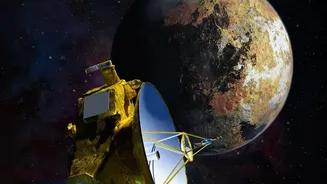
That all changed on July 14, 2015, when NASA's New Horizons spacecraft flew past Pluto, providing our first-ever close-up look. The images sent back were stunning and completely upended expectations. Instead of a heavily cratered, static surface, New Horizons revealed vast, smooth plains, towering mountains of water ice, and a complex atmosphere with haze layers. Most surprisingly, some surfaces were almost entirely free of craters, a clear sign of recent geological activity that has paved over older features. Pluto was not dead; it was startlingly alive.
The Secrets of a Nitrogen Heart
The most prominent feature is a massive, heart-shaped basin of frozen nitrogen called Sputnik Planitia. This region, larger than Texas and Oklahoma combined, shows no impact craters, suggesting its surface is no more than 10 million years old—a geological infant. The ice here is organized into city-sized polygonal cells that churn slowly, like a colossal lava lamp or oatmeal simmering on a stove. This convection is driven by a modest heat source from Pluto's interior. Recent studies analyzing dark streaks on the glacier suggest that liquid nitrogen may even seep up from below the surface, temporarily wetting the ice. This would be the first evidence of recently flowing liquid on Pluto, a concept once thought impossible given the extreme cold.
Volcanoes That Spew Ice
Perhaps the most dramatic evidence for recent activity is the presence of enormous cryovolcanoes, or ice volcanoes. Features like Wright Mons, which rivals the scale of Mauna Loa in Hawaii, are not mountains in the earthly sense. Instead of spewing molten rock, they appear to have erupted a slushy mixture of water ice, ammonia, and other substances from Pluto's interior. The lack of craters on these structures indicates they were formed relatively recently in geological time. One feature, Kiladze, initially thought to be an impact crater, is now suspected to be the caldera of a supervolcano that may have erupted within the last few million years.
A New Understanding of Icy Worlds
The discovery of such recent and varied geological processes forces a complete rethink of how small, icy worlds evolve. The key question is: where does the heat come from? Scientists are exploring two main possibilities: heat from the radioactive decay of elements in Pluto's rocky core, or heat retained from its formation, insulated by a possible subsurface ocean of liquid water. The presence of features like landslides also points to an active, changing surface. Pluto is teaching us that even in the coldest, darkest corners of the solar system, the right ingredients can keep a world geologically active for billions of years, creating unique landscapes seen nowhere else.