



The Old View: Ancient and Enduring
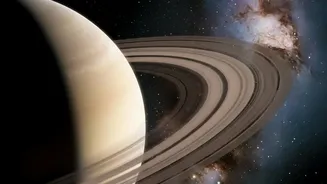
For much of astronomical history, the default assumption was that Saturn's rings were as old as the planet itself, forming some 4.5 billion years ago from the same primordial disc of gas and dust. They were seen as a static, almost permanent feature—a
timeless celestial halo. Made almost entirely of water ice particles ranging in size from tiny grains to massive boulders, the rings' sheer brightness and expanse seemed to suggest they were a fundamental part of the planet's identity. This long-held belief was based on the idea that such a massive and complex structure must have taken billions of years to form and stabilize. Scientists believed that over eons, the pristine ice would have been darkened by a constant bombardment of micrometeoroids, but the rings' brightness remained a puzzle.
Cassini's Grand Finale Changes Everything
Our entire understanding was upended by NASA's Cassini mission, which orbited Saturn for 13 years before its dramatic 'Grand Finale' in 2017. In its final orbits, the spacecraft dove into the previously unexplored gap between the planet and its rings. This daring maneuver allowed for unprecedented measurements of the rings' mass and the rate at which interplanetary dust was 'polluting' them. The data was stunning. Scientists found that the rings were remarkably 'clean,' containing far less dusty contamination than would be expected if they had been around for billions of years. This cleanliness pointed to a much younger age. Furthermore, Cassini was able to essentially 'weigh' the rings, finding them to be less massive than some previous estimates suggested, which also supported the idea of a more recent origin.
A Surprisingly Young Creation
The Cassini data has led to a new consensus: Saturn's rings are not 4.5 billion years old, but likely formed just 100 to 400 million years ago. To put that in perspective, they probably came into existence when dinosaurs still roamed the Earth. This has sparked a flurry of new theories about their origin. The leading hypothesis is that the rings are the shattered remnants of a celestial body that strayed too close to Saturn. One compelling theory suggests an icy moon, nicknamed 'Chrysalis,' had its orbit destabilized and was torn apart by Saturn's immense gravity. Computer simulations show that such an event could have resulted in the planet swallowing most of the moon's rocky core while its icy mantle was shredded to form the bright, ice-rich rings we see today.
It's Raining on Saturn
Not only are the rings young, but they are also actively disappearing. Cassini and other observatories have confirmed a phenomenon known as 'ring rain,' where particles from the rings are being pulled into Saturn's upper atmosphere by the planet's gravity and magnetic field. This isn't a gentle drizzle; scientists describe it as a 'downpour,' with thousands of kilograms of water and other molecules falling onto the planet every second. This constant loss of material means the rings are living on borrowed time. The rate of this 'rain' suggests that the entire ring system could vanish in as little as 100 million years, and will certainly be gone in a few hundred million years. Far from being permanent, we are lucky to be living in an era where we can see them at all.
Lingering Mysteries and Future Missions
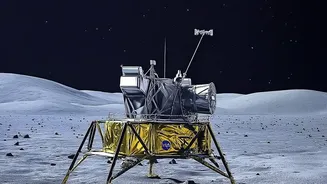
While the science has evolved dramatically, many questions remain. While the 'shattered moon' theory is popular, some recent research has challenged the young-ring hypothesis, suggesting the rings might be self-cleaning, which would allow for an older age. The debate continues, highlighting just how complex the system is. To solve these mysteries, scientists are looking to the future. A proposed NASA mission concept called PRAXIS (Planetary Rings Autonomous EXploration with In-situ Sampling) aims to send a robotic explorer to actually touch and collect particles from the rings for the first time. By analyzing these samples directly, we could finally get definitive answers about their composition and origin, writing the next chapter in the ever-evolving story of Saturn's glorious rings.