



The Power of Pure Light
The first step in understanding this preference is to appreciate the advantage of a monochromatic, or black-and-white, sensor. Unlike a standard colour camera, which uses a built-in filter grid (called a Bayer matrix) to assign red, green, or blue values
to pixels, a mono sensor is pure. Every single pixel is dedicated to capturing one thing: the intensity of light, or luminance. This seemingly simple difference has profound implications. A mono sensor is inherently more sensitive, often capturing up to three times more light than its colour counterpart in the same amount of time. This is because in a colour camera, a red photon hitting a pixel with a green or blue filter is simply lost. With a mono camera, every photon counts, resulting in cleaner, more detailed, and higher-resolution images. This heightened sensitivity is a massive advantage when your subject is millions of light-years away.
Painting the Cosmos with Filters
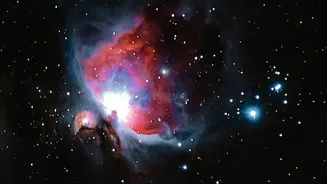
If the camera only sees in black and white, how are the vibrant colours of cosmic clouds created? The magic happens with specialized filters. Photographers use a filter wheel that sits in front of the mono sensor, allowing them to shoot the same object multiple times, each time through a different coloured filter. The most common method is LRGB imaging, where the camera captures separate images in Luminance (a clear filter for maximum detail), Red, Green, and Blue. In post-processing, these individual black-and-white images are stacked and assigned to their respective colour channels to build a final, full-colour photograph. This method gives the photographer complete control over the final image, allowing them to balance colours and enhance detail in a way that is impossible with a one-shot colour camera.
Seeing the Invisible with Narrowband
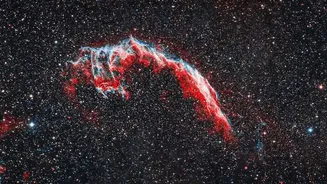
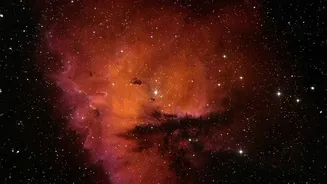
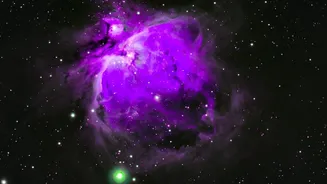
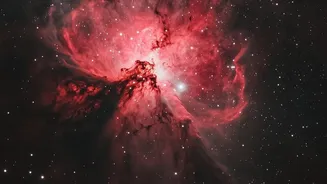
Beyond standard colour, this technique unlocks an even more powerful tool: narrowband imaging. Many celestial objects, like emission nebulae, are vast clouds of ionized gas. These gases glow at very specific wavelengths of light, such as Hydrogen-alpha (Ha), Sulphur-II (SII), and Oxygen-III (OIII). Narrowband filters are designed to capture only these specific, narrow slices of the light spectrum. This has two huge benefits. First, it allows photographers to isolate and highlight the intricate structures of these gases, creating the dramatic, high-contrast images famously produced by the Hubble Space Telescope. Second, because these filters block out almost all other light, they are incredibly effective at cutting through urban light pollution, enabling breathtaking astrophotography even from a city.
The Case for Uncooled Cameras
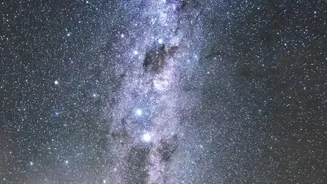
The final piece of the puzzle is the preference for 'uncooled' cameras. For serious deep-space imaging involving very long exposures, most advanced photographers use cameras with active cooling systems. These systems chill the sensor to minimize thermal noise, which appears as unwanted grain in an image. However, the headline's claim isn't wrong; it just applies to a specific style of night-sky photography. Many photographers, especially those capturing nightscapes (landscapes with the Milky Way) or doing planetary imaging, use shorter exposures where thermal noise is less of a factor. For them, an uncooled camera is often preferred for its lower cost, smaller size, lighter weight, and lower power consumption—all significant advantages when hiking to a remote, dark-sky location. The simplicity and portability of an uncooled setup make it a practical and powerful choice for many applications.