




Beyond the Bottomless Pit
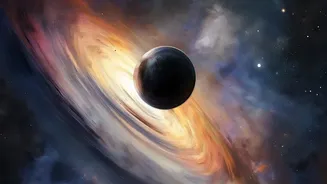
The classic image of a black hole is a simple one: an inescapable gravitational abyss that swallows everything, from dust to entire stars, without a trace. For years, this model of a cosmic vacuum cleaner has dominated our understanding. While scientists
knew the process was more complex, the general assumption was that what goes into a black hole, stays in a black hole. However, a wave of new observations suggests this picture is far too simple. Recent studies show that black holes are not just passive consumers; they are active and dynamic systems that process and eject a surprising amount of the material they draw in. This changes our perception of them from mere gluttons to powerful engines that actively reshape their cosmic neighborhoods.
A Cosmic Digestive System
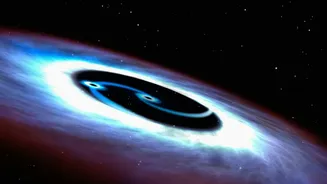
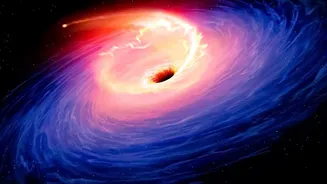
Observations of a black hole system named Swift J1727.8-1613, which experienced a dramatic outburst in 2023, have provided a front-row seat to this complex process. A team of astronomers, using the European Southern Observatory’s Very Large Telescope, watched as the black hole pulled gas from a neighbouring star. But instead of just swallowing it, the black hole also launched powerful jets and winds of material back into space. Researchers have described it as a kind of 'cosmic digestive system'. Matter falls in, swirls around in a hot, chaotic disk, and a significant portion gets processed and expelled before it ever crosses the point of no return. This suggests black holes are far less efficient eaters than we once thought.
The Messy Eater Theory
Perhaps the most startling finding is what happens after the main meal. Even after the black hole's feeding frenzy died down to just one percent of its peak brightness, it continued to spew out dense gas. This suggests the 'fireworks' of a black hole are not just at the start of an outburst, but the finale can be just as intense. According to Dr. Noel Castro Segura of the University of Warwick, a significant fraction of a black hole's 'meal' may never actually be consumed at all. This messy eating has huge implications, not just for the black hole itself, but for how stars and galaxies evolve around it, as this expelled material is redistributed throughout space.
Decades of Watching and Waiting
These new insights are not the result of a single discovery, but the culmination of years, and sometimes decades, of patient observation. The Event Horizon Telescope, a global network of observatories, has been monitoring supermassive black holes like the one at the center of the M87 galaxy for years. By tracking changes in the environment around the black hole between 2017 and 2021, they observed its magnetic field completely flip, proving the area is a dynamic and turbulent place. Similarly, gravitational wave observatories like LIGO have spent over a decade tracking the mergers of black holes, with each detection providing richer data and confirming fundamental theories, such as Stephen Hawking's area theorem. These long-term projects are building a new, more nuanced picture of these cosmic enigmas.