



First, Let Your Eyes Adjust
Before you start looking for specific objects, the most important step is to adapt to the darkness. Find a spot away from direct streetlights or house lights. It takes about 20 to 30 minutes for your eyes to become fully sensitive to low light, revealing
thousands more stars than are visible at a first glance. Put your phone away, as its bright screen will instantly ruin your night vision. If you need a light, use a torch with a red filter, as red light is less disruptive to your eyes.
Look for the Ringed Planet: Saturn
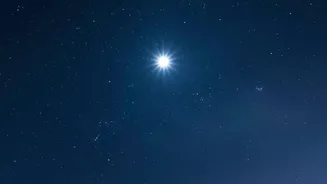
October 2026 is a fantastic month for viewing Saturn. The planet reached 'opposition' on October 4, meaning Earth is passing directly between it and the Sun. This makes Saturn visible all night long and at its brightest for the year. To the naked eye, it won’t look like a ringed ball but will appear as a distinctly bright, steady, pale-yellow point of light that doesn't twinkle like a star. Look for it in the eastern sky after sunset, where it will be the brightest object in its patch of sky, moving westward as the night progresses. It's an easy and rewarding target for any beginner.
Find the Morning Giants: Jupiter and Mars
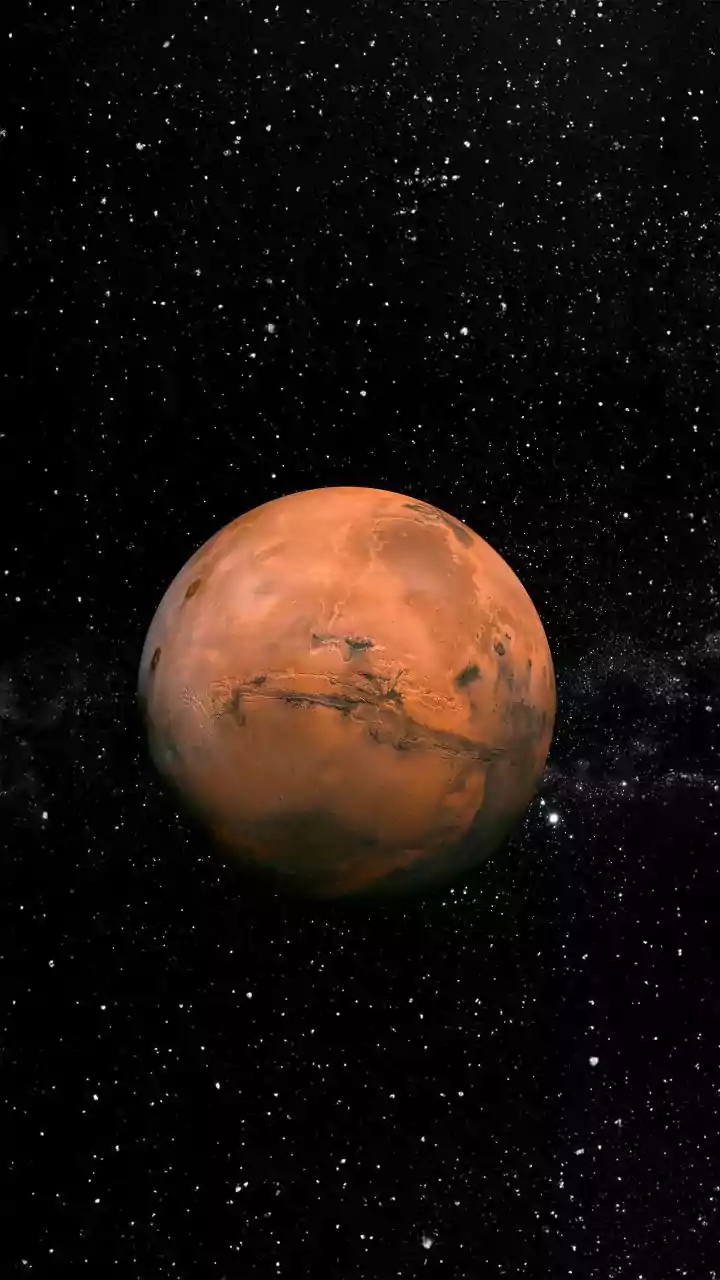
If you're an early riser, the pre-dawn sky has its own rewards. Jupiter will be a dominant, brilliant object high in the eastern sky before sunrise. Not far from it, you'll find Mars, which can be identified by its distinct reddish hue. In early October, Mars can be seen rising before 1:30 a.m. near the Beehive star cluster in the constellation of Cancer. Both planets are incredibly bright and easy to spot without any equipment, standing out clearly against the backdrop of stars.
Catch a Falling Star: The Orionid Meteor Shower
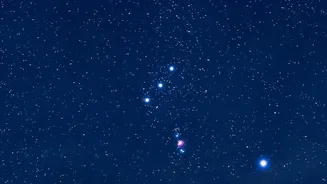
October hosts the Orionid meteor shower, which is active from early October to early November. This shower is caused by debris left behind by the famous Halley's Comet. The peak of the shower will occur on the night of October 21-22. For the best view in 2026, you'll want to look in the hours before dawn, after the bright moon sets around 3 a.m. Under dark skies, you could see 15 to 25 meteors per hour. The meteors will appear to radiate from the constellation Orion, but they can streak across any part of the sky, so just lie back and look up.
Trace the Great Square and the Queen
Constellations are the maps of the night sky. In October, look high in the northeast for a large 'W' shape of stars—this is Cassiopeia, the Queen. Another easy-to-spot pattern is the Great Square of Pegasus, a large boxy formation of four bright stars visible in the eastern sky after dark. This asterism serves as a great starting point to navigate to other objects. For instance, Saturn will be visible below the Great Square this month.
A Faint Glimpse of Another Galaxy
If you are in a location with very dark skies, away from city light pollution, you have a chance to see the most distant object visible to the human eye: the Andromeda Galaxy. In October, it's positioned high in the northeastern sky. To the naked eye, it won't look like a grand spiral, but rather a small, faint, elongated smudge of light. It can be tricky to find, but spotting this galaxy—a collection of a trillion stars over 2.5 million light-years away—with your own eyes is an unforgettable experience. The post-monsoon clarity of October makes it one of the best times to try.
The Last Look at the Milky Way's Core
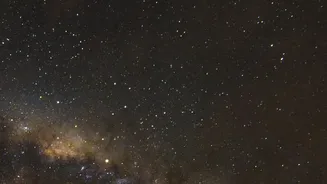
The bright, dense centre of our own galaxy, the Milky Way, is a breathtaking summer sight. In early October, you can still catch its final appearance for the season. Look toward the southwest just after sunset, where the star clouds of the constellations Sagittarius and Scorpius hang low on the horizon before setting. This part of the sky is the brightest section of the Milky Way band. By November, it will have dipped below the horizon until next year, so this is your last chance to see it in its full glory.