




Your Stargazing Toolkit
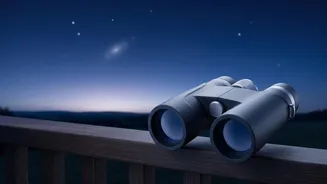
The key to unlocking these celestial sights is a good pair of binoculars. When we say 'basic', we're not talking about compact opera glasses. For astronomy, you’ll want something that balances magnification (how much closer an object appears) with aperture
(the diameter of the main lenses, which determines how much light is gathered). Binoculars with specifications like 7x50 or 10x50 are ideal for beginners. The first number is the magnification, and the second is the aperture in millimetres. These models gather enough light to make faint objects visible while having a wide enough field of view to easily scan the sky. The most critical factor, however, is stability. Even the slightest handshake can make a pinpoint of light dance wildly, obscuring details. If you don’t have image-stabilised binoculars, brace them against a fence, a car roof, or mount them on a simple tripod to get a steady view.
Setting the Celestial Stage
Before you start your cosmic hunt, set yourself up for success. The most important step is to get away from city lights. Light pollution washes out faint objects, so finding a dark spot in a park, field, or even a suburban backyard with minimal direct lighting is crucial. Once you're there, give your eyes at least 15-20 minutes to fully adapt to the darkness; you'll be amazed how many more stars become visible. Using a star chart or a smartphone app can be incredibly helpful. Apps like Stellarium or SkySafari can show you exactly where to look from your specific location at any given time. Finally, dress warmly. Autumn nights can get chilly, and you’ll enjoy the experience much more if you’re comfortable.
Finding Jupiter, the King of Planets
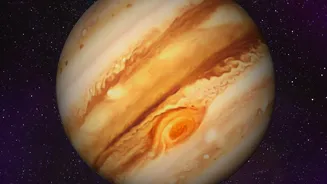
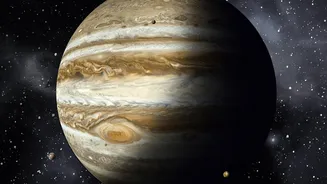
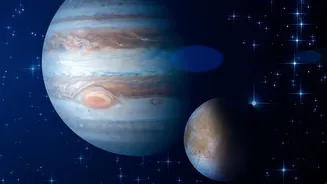
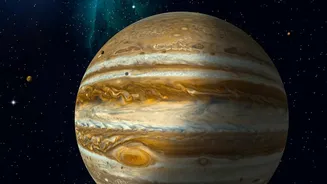
During autumn 2026, Jupiter will be a brilliant beacon in the morning sky. You won't be able to miss it—it shines brighter than any star. Look towards the east-southeast before sunrise. In early autumn, specifically around October, Jupiter will be found near the constellation Leo, shining brightly near the star Regulus. To the naked eye, it’s a steady, intensely bright point of light. When you raise your binoculars, that point will resolve into a tiny, distinct disc. This simple transformation is the first reward of your binocular journey, but the real prize lies right beside it.
A Dance of Moons
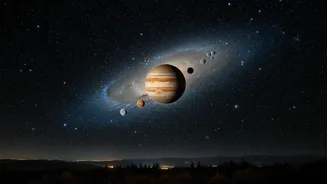
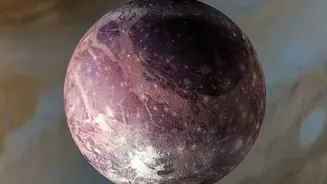
The four largest moons of Jupiter—Io, Europa, Ganymede, and Callisto—are known as the Galilean moons, after Galileo Galilei discovered them in 1610. Through your stabilised binoculars, they will appear as tiny, star-like pinpricks of light arranged in a line that seems to pass right through Jupiter. On any given night, you might see all four, or you might see only two or three if the others are hidden behind or in front of the planet. Their positions change nightly, and even over the course of a few hours, offering a dynamic view of a miniature solar system in motion. Seeing these moons for yourself is a powerful experience, connecting you directly to a pivotal moment in the history of science.
Hunting for the Andromeda Galaxy
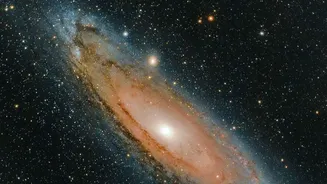
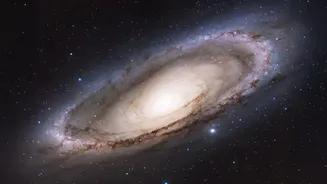
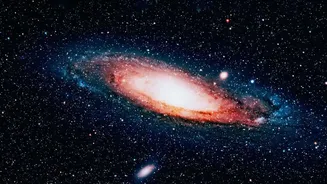
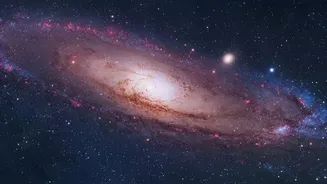
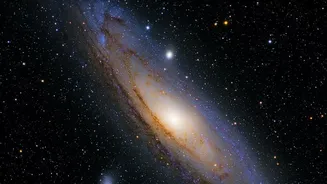
The Andromeda Galaxy, also known as M31, is the most distant object you can see with your naked eye. Autumn is the prime season to view it, as it climbs high in the evening sky. To find it, start by locating the W-shaped constellation Cassiopeia high in the northeast. The 'V' on the right side of the 'W' acts like an arrow in the sky, pointing roughly in Andromeda's direction. Another helpful guidepost is the Great Square of Pegasus. The galaxy lies between Cassiopeia and Pegasus. Using your binoculars, slowly sweep the area indicated by Cassiopeia's 'arrow.' Don't look for a sparkling star. Instead, you are searching for a faint, fuzzy, oval-shaped smudge of light. This ethereal glow is our closest major galactic neighbour, a sprawling city of a trillion stars, 2.5 million light-years away.