


More Than Just a Walk
Originating in Finland as a summer training method for cross-country skiers, Nordic walking has become a global fitness activity. Unlike regular walking, which primarily uses muscles in the lower half of the body, Nordic walking incorporates specially
designed poles to engage the upper body, core, and legs simultaneously. Research shows that this technique can activate up to 90% of your body's muscles, compared to just 50% with conventional walking. This increased muscle engagement turns a simple walk into a comprehensive, calorie-burning workout that is surprisingly gentle on the joints.
The Science-Backed Benefits
The appeal of Nordic walking lies in its impressive and well-researched health advantages. Studies have shown it can burn up to 20%, and in some cases even more, calories than regular walking at the same pace. This is because you are actively using your arms, shoulders, and core muscles to propel yourself forward. It has been linked to significant improvements in cardiovascular health, with one study finding it more effective at boosting functional capacity in cardiac patients than high-intensity interval training (HIIT). Furthermore, the use of poles provides greater stability, reduces stress on the knees and hips, improves posture, and can help alleviate chronic pain and stiffness.
Getting the Gear Right
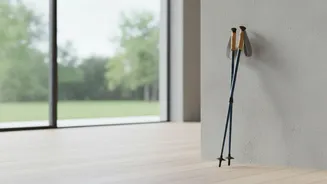
Before you start, it’s crucial to understand that Nordic walking poles are not the same as hiking or trekking poles. Trekking poles are designed for stability on uneven, mountainous terrain and have simple wrist straps. Nordic walking poles, however, are built for propulsion on flatter surfaces. They feature a special glove-like strap system that allows you to release your grip on the pole's handle during the backswing, a key part of the technique. The poles should also be the correct height; a common rule of thumb is your height in centimetres multiplied by 0.68. Using poles that are too long or too short can lead to poor form and potential strain.
Mastering the Correct Technique
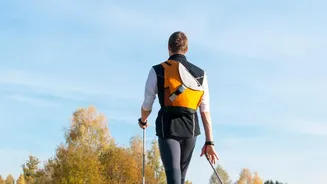
The secret to unlocking Nordic walking's full potential is proper form. The movement should feel natural and rhythmic. It follows the same cross-lateral pattern as regular walking: as your right leg steps forward, your left arm swings forward with the pole, and vice versa. The key steps are: 1. Keep an upright posture, looking forward, not at the ground. 2. Swing your arms from the shoulder, not the elbow, keeping them relatively straight. 3. Plant the pole tip on the ground roughly level with the heel of your opposite foot. 4. As you stride forward, push through the pole strap, extending your arm behind you to propel yourself forward. 5. Open your hand at the end of the arm swing to let the pole swing freely, guided by the strap, before bringing it forward for the next plant.
Common Mistakes to Avoid
Many beginners make a few common errors that reduce the effectiveness of the workout. One major mistake is planting the poles too far in front of the body, which acts as a brake rather than a propeller. Another is holding the pole grips with a constant, tight fist, which prevents the proper push-off and can strain your wrists. Remember to open your hand on the backswing. Also, avoid using your elbows instead of your shoulders to move the poles; the power comes from the larger muscles of the upper body and back. Finally, many people initially struggle with coordination, moving the arm and leg on the same side together. If this happens, try dragging the poles behind you for a few moments while walking normally to reset your natural rhythm.