





A Legacy of Success
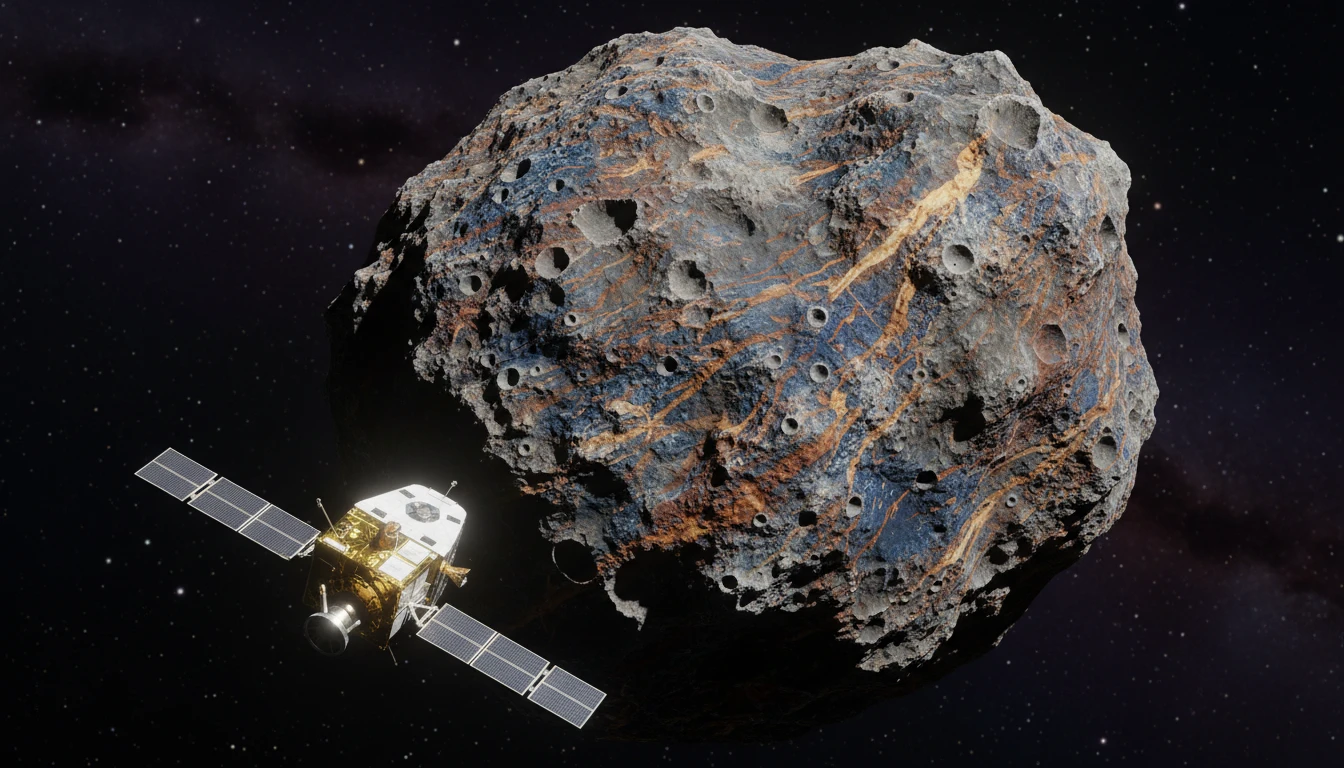
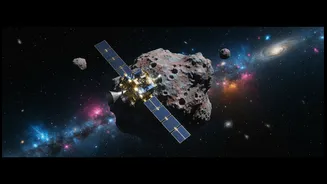
To understand where Hayabusa2 is going, it is essential to remember where it has been. The probe, operated by the Japan Aerospace Exploration Agency (JAXA), already has one historic achievement under its belt. In 2019, it successfully collected samples
from Ryugu, a carbon-rich asteroid, and returned them to Earth in 2020. The analysis of these precious materials has been nothing short of revolutionary, revealing the presence of water and organic molecules, the fundamental building blocks of life, preserved in the asteroid's soil. This initial success cemented Hayabusa2's place in space exploration history and provided the foundation for its current, even more challenging extended mission.
Torifune: A High-Speed Rehearsal
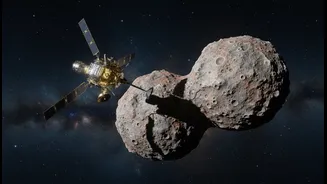
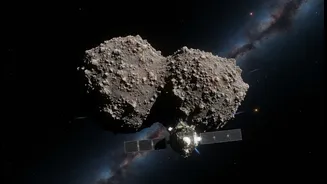
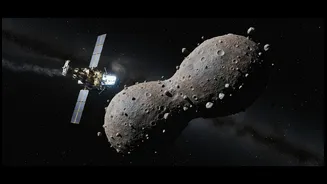
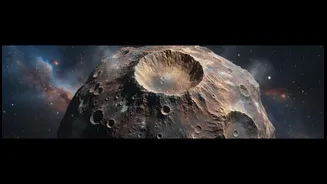
The flyby on July 5, 2026, brought Hayabusa2 within a close range of Torifune, an asteroid approximately 450 meters long. Images revealed it to be a "contact binary," which looks like two lumpy asteroids stuck together. Traveling at a relative speed of over 18,000 kilometers per hour, the encounter was a crucial test of JAXA's precision navigation abilities. Because asteroids are dark and their orbits can be uncertain, the team had to make last-minute adjustments to guide the spacecraft safely. This maneuver was more than just a photo opportunity; it was a critical dress rehearsal for a key global priority: planetary defense. The exercise helped demonstrate the kind of rapid reconnaissance needed to assess a potentially hazardous asteroid if one were ever found on a collision course with Earth.
The Marathon to 1998 KY26
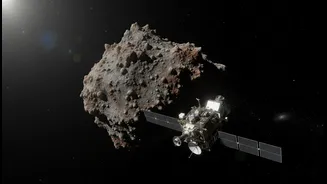
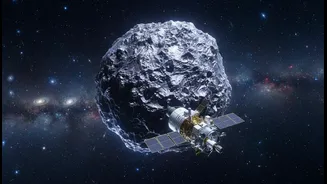
The Torifune flyby is just a stepping stone. Hayabusa2’s ultimate destination is a tiny, mysterious asteroid named 1998 KY26. The probe isn't scheduled to arrive until July 2031, after executing two swing-by maneuvers around Earth in 2027 and 2028 to adjust its trajectory. This decade-long journey highlights the immense patience and long-term planning required for deep space exploration. The target, 1998 KY26, is what makes this next phase so compelling. It's an incredibly small object, estimated to be only about 30 meters in diameter, and it spins with astonishing speed, completing a full rotation in about 10 minutes. No spacecraft has ever rendezvoused with such a small, fast-rotating body before.
Science on a Spinning Space Rock
Studying 1998 KY26 offers a unique scientific opportunity. Its rapid rotation means the centrifugal force on its surface is likely stronger than its own gravity, creating a physical environment unlike anything explored up close. Scientists are eager to understand what holds such a body together. Most large asteroids are thought to be loose "rubble piles" bound by gravity, which would fly apart if they spun this fast. A small, solid body like 1998 KY26 could be a monolithic piece of rock, perhaps a fragment from a larger body shattered by a collision long ago. Understanding its composition and structure is vital for planetary defense. Objects of this size are large enough to cause significant damage if they hit Earth, similar to the Chelyabinsk event in 2013, but are very difficult to detect with ground-based telescopes. A close-up study would provide invaluable data for developing strategies to deflect a potential threat.
A Shared Human Endeavour
While Hayabusa2 is a Japanese mission, its goals are universal. The quest to understand the origins of our solar system and how to protect our planet resonates with scientists and citizens worldwide, including in India. As India's own space program continues to reach new heights, missions like Hayabusa2 serve as both inspiration and a source of shared knowledge. The data gathered on the nature of asteroids and the technologies developed to explore them contribute to a global pool of scientific understanding. The probe's extended mission is a testament to engineering reliability and scientific ambition, pushing the boundaries of what is possible in our exploration of the cosmos.