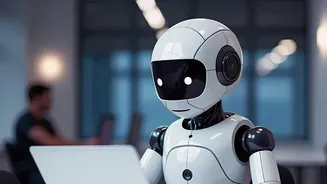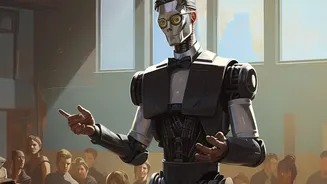





The promise is immense: a personal, artificially intelligent tutor for every student. Yet, as ed-tech companies race to put AI in every virtual classroom, groundbreaking US research suggests a more complicated reality.
The Billion-Dollar Question
Artificial intelligence in education
is no longer a futuristic concept; it's a booming industry. Parents and educators are increasingly turning to AI-powered platforms that promise personalised learning, instant feedback, and academic acceleration. The premise is simple: what if every student could have a one-on-one guide available 24/7? However, a recent wave of studies from American universities and research institutes is injecting a crucial dose of reality into the hype. The findings are surprisingly nuanced. Some highly controlled studies show AI tutors can be remarkably effective. Yet, large-scale, real-world trials paint a different picture. One significant randomised trial at the University of Maryland found that providing undergraduates with a course-integrated AI assistant actually led to lower final grades by as much as 0.37 standard deviations. This raises a critical question: why isn't more tech always the answer?
The Engagement Gap
One of the most significant hurdles for AI tutors isn't their intelligence, but student engagement. Researchers consistently find a massive gap between having access to a tool and using it effectively. A major two-year study on Khan Academy's Khanmigo AI tutor in Tennessee middle schools found that while the tool was available, the median student used it on only a third of their practice days. More strikingly, they only turned to the AI in 17% of the sessions where they actually made a mistake. The University of Maryland study was even more stark: only about 15% of students offered the AI tutor used it at all. Without the accountability or relationship offered by a human, many students simply don't use the tools, or use them passively by asking for direct answers rather than engaging in a real learning dialogue.
Learning vs. Performance
Another key finding distinguishes between shortterm performance and longterm learning. Several studies show that students often perform better on tasks right in front of them when using an AI assistant. However, those gains frequently vanish when the tool is taken away for a test. One study found that students using a less constrained AI math tutor performed better during practice but scored 17% worse than a control group when tested without the AI later. This suggests some tools may be creating a dependency, helping students complete assignments without ensuring they internalise the concepts. The goal of tutoring isn't just to get the right answer now, but to build the skills to find the right answer on your own later. On that front, the evidence for standalone AI tutors is mixed at best.
The HumanAI Hybrid Model
The research isn't a verdict against AI in education, but a clarification of its role. The most promising results emerge not from replacing humans, but from augmenting them. The strongest evidence of effectiveness comes from models where AI tools are used by human tutors to enhance their teaching. For example, Stanford's Tutor CoPilot, which gives realtime suggestions to human tutors, helped their students master topics more effectively. This hybrid approach leverages the strengths of both worlds : the scalability, data analysis, and tireless practice provided by AI, combined with the motivation, mentorship, and emotional intelligence that only a human tutor can provide. An AI can't yet sense a student's frustration or inspire them to persist through a difficult concept in the same way a person can.
Making Smart Choices
For parents and students in India navigating a crowded market of edtech solutions, these findings are a valuable guide. The effectiveness of an 'AI tutor' depends entirely on its design and how it's used. A tool that simply gives answers is less valuable than one that uses a Socratic method to guide a student to their own conclusions. Furthermore, the research powerfully suggests that AI is best used as a supplement, not a replacement. It can be a fantastic tool for practice, revision, and instant explanation. But the core of deep learning still often relies on the uniquely human connection between a student and a great teacher. The most effective strategy may be to use AI for daily practice while relying on human interaction for complex understanding and motivation.