
A Star's Final Act
For stars like our Sun, life is a multibillion-year balancing act between gravity crushing inwards and nuclear fusion pushing outwards. For about 90% of their lives, they are 'main-sequence' stars, steadily converting hydrogen into helium in their cores.
But when the hydrogen runs out, the end begins. The star's core collapses, heating up and causing its outer layers to swell dramatically, transforming it into a red giant. This phase is catastrophic for any nearby planets; in our own solar system, Mercury, Venus, and possibly Earth will be engulfed when the Sun becomes a red giant in about 5 billion years. After this phase, the star sheds its outer layers, creating a beautiful, glowing structure called a planetary nebula. What’s left behind is the star’s incredibly dense, hot core: a white dwarf.
The Ghost of a Star
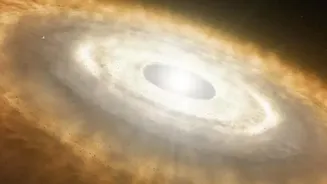
A white dwarf is an Earth-sized ember, packing the mass of a star into a much smaller volume. It no longer generates new heat through fusion, so it simply cools down over billions of years. Any planets that survived the red giant phase would have been pushed into distant, unstable orbits or destroyed entirely. For a long time, white dwarfs were seen as stellar graveyards. However, astronomers began noticing something odd: the atmospheres of many white dwarfs were 'polluted' with heavy elements like silicon, iron, and magnesium. Since a white dwarf's intense gravity should quickly pull these heavy elements below the surface, their presence implies the star is actively feeding on something—most likely the shredded remains of asteroids or other rocky bodies that have strayed too close. This debris forms a dusty disk, a cosmic boneyard of the original planetary system.
From Debris to a New World
This is where the idea of a 'second-generation' planet comes in. What if that disk of pulverised asteroids and stellar material doesn't just get eaten, but instead clumps together to form entirely new planets? This process would be a form of cosmic recycling, creating new worlds long after the star's fiery death. The idea has been debated for decades, but recent evidence has brought it into sharp focus. In early October 2026, a team led by astronomers from the University of Warwick announced a groundbreaking discovery around a white dwarf named HS 0209+0832. By analysing 25-year-old data from the Hubble Space Telescope, they found something completely unexpected.
The Niobium Smoking Gun
The atmosphere of HS 0209+0832 was polluted, but not just with the usual rock-forming elements. It contained unusually high levels of zinc, copper, and most notably, niobium. The concentration of niobium was about 1,000 times higher than that found in our Sun. This is the crucial clue, because niobium is an element primarily forged inside a star during its final, giant phase—a process that should have cast it far into space. Finding so much of it raining down onto the white dwarf strongly suggests it was first incorporated into a new object that formed from the star's own ejected material. That object, astronomers believe, is a Jupiter-sized gas giant, a second-generation planet born from the ashes of its parent star. Data from NASA's TESS satellite also detected a repeating 4.4-day signal, consistent with a large planet in a very tight orbit.
A Second Chance for Life?
While this candidate planet is a gas giant being blasted by its hot parent star, the discovery opens a fascinating new chapter in our understanding of planetary formation. It proves that the environment around a stellar remnant is not necessarily barren, but can be a cradle for new worlds. This has profound implications. White dwarfs are extremely common; the vast majority of stars, including our Sun, will end their lives this way. These embers cool very slowly, meaning a rocky planet formed in the right orbit—the 'habitable zone'—could potentially maintain liquid water on its surface for billions of years, far longer than Earth's remaining habitable lifetime. If this discovery is confirmed, it suggests that even after a star dies, its system can have a second act, potentially hosting a new generation of planets. The story of a solar system may not end with the death of its star, but merely enter a new, unexpected chapter.